





Offshore transformer fire safety: how mineral oil substitution affects IEC 61936 compliance
2026.09.22
Jinshida
Offshore transformer fire safety is non-negotiable—especially when fire risk mitigation directly impacts IEC 61936 compliance. As mineral oil substitution gains traction in harsh marine environments, quality control and safety professionals must assess how alternative dielectric fluids affect thermal stability, arc resistance, and system-level fire safety certification. This article examines the technical implications of replacing conventional mineral oil with ester-based or synthetic fluids in offshore transformers, clarifying alignment (or misalignment) with IEC 61936-1:2023 requirements for electrical installations in high-risk locations. Jinshida Electric’s engineering insights support your risk-informed decision-making.
IEC 61936-1:2023 explicitly classifies offshore platforms as “locations with increased risk of fire,” requiring electrical equipment to meet stringent fire performance criteria—not just for individual components, but for the integrated installation. Clause 5.3.2 mandates that oil-immersed transformers installed in such locations “shall be designed to limit fire propagation, minimize fuel contribution, and ensure containment or suppression capability.” Crucially, the standard does not prescribe fluid type—but it defines performance thresholds that *must* be verified through test-based evidence, not material substitution alone.
Mineral oil has long served as the baseline reference in fire-related testing protocols referenced by IEC 61936, including IEC 60076-22 (fire safety test methods for liquid-immersed transformers) and IEC 60851 (combustibility classification of insulating liquids). Its flash point (~145 °C), autoignition temperature (~360 °C), and heat release rate under forced ignition are well-documented and form the basis for fire modeling used in platform hazard assessments. Substituting with biodegradable esters or synthetic hydrocarbons alters this baseline fundamentally: ester fluids typically exhibit higher flash points (≥300 °C), lower volatility, and significantly reduced heat release rates—but their pyrolysis behavior under sustained arcing differs markedly from mineral oil. Under fault conditions involving prolonged internal arcing, esters decompose into low-molecular-weight organic acids and aldehydes, which may corrode copper windings and degrade paper insulation faster than mineral oil degradation products. This does not disqualify them—but it shifts the failure mode from rapid flame propagation to accelerated insulation aging and potential secondary faults, a nuance rarely captured in simplified “fire-safe” marketing claims.
Compliance hinges on whether the *entire transformer system*—not just the fluid—meets the fire safety objectives of IEC 61936-1:2023. That includes tank integrity under fire exposure, pressure relief design, secondary containment capacity, and compatibility between fluid, solid insulation, and sealing materials. For example, some ester formulations swell ethylene-propylene rubber (EPR) gaskets over time, compromising tank seal integrity during extended operation—a failure mode irrelevant to mineral oil but critical for offshore service life. Similarly, synthetic hydrocarbon fluids with low surface tension may penetrate micro-cracks in aged epoxy bushings more readily, increasing leakage risk in high-humidity, salt-laden atmospheres. These interactions fall outside the scope of fluid-only certification (e.g., ASTM D6180 or IEC 61099) but directly impact system-level fire safety verification required by IEC 61936.
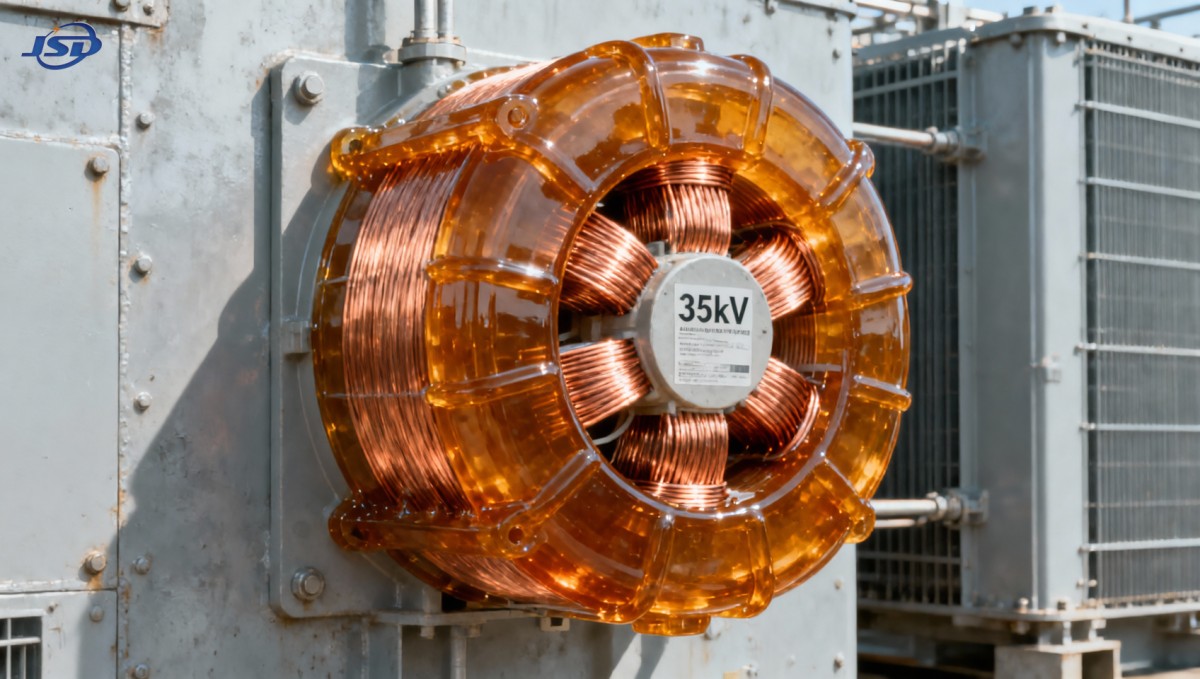
Dry-type alternatives sidestep fluid-related fire risks entirely—and this is where design intent matters most. A 35kV Three-Phase Cast Resin Dry-Type Distribution Transformer eliminates flammable liquid inventory altogether, inherently satisfying the core fire safety objective of IEC 61936-1:2023 Clause 5.3.2(a): “reduction of fire load.” Its F1-class fire performance—verified per IEC 60076-22 Annex B—is achieved not through fluid substitution, but through thermosetting epoxy resin encapsulation, flame-retardant filler integration, and vacuum-cast structural integrity. Unlike fluid-filled units, its fire response is dominated by charring behavior rather than flaming combustion, with no risk of boilover or pool fire escalation. For offshore applications where space constraints limit secondary containment volume—or where evacuation timelines demand absolute certainty of non-flammability—this architecture represents a deterministic compliance path, not a probabilistic one.
Yet dry-type solutions introduce different verification demands. IEC 61936-1:2023 requires thermal management systems to be validated under worst-case ambient conditions: 40 °C ambient, 100% relative humidity, and salt-laden air. Epoxy-resin transformers rely on natural convection or forced-air cooling; their derating curves must account for marine-specific fouling of cooling surfaces and reduced convective efficiency at elevated humidity. The 35kV Three-Phase Cast Resin Dry-Type Distribution Transformer’s rated 120% overload capability under forced-air cooling assumes clean, unobstructed airflow—a condition rarely maintained without scheduled maintenance in offshore environments. Without documented derating data validated against IEC 60076-2 and IEC 60076-14 (for dry-type units), claiming full compliance under Clause 5.3.3 (“thermal safety”) becomes technically unsupported.
The key distinction lies in *what is being certified*. Mineral oil substitution targets fluid flammability metrics; dry-type design targets elimination of the hazard source. IEC 61936-1:2023 does not rank these approaches—it requires demonstrable achievement of fire and thermal safety outcomes. For quality and safety teams, this means shifting focus from “does this fluid pass ASTM D92?” to “does this complete transformer assembly—fluid, tank, seals, bushings, and cooling system—produce test evidence acceptable to the platform’s certifying authority (e.g., DNV, ABS, or LR) under IEC 61936-1:2023 Annex E?” There is no shortcut: third-party witnessed fire testing (e.g., IEC 60076-22 fire tunnel test), accelerated aging studies under simulated marine conditions, and documented thermal modeling under realistic site-specific ambient profiles are non-negotiable inputs for compliance documentation.
 This leads to a practical implication often overlooked in procurement reviews: compliance is not transferable between platforms. A transformer certified for fire safety on a Norwegian North Sea platform—with its specific ventilation layout, firewater deluge coverage, and emergency shutdown sequence—may require revalidation for a Gulf of Mexico installation due to differences in ambient temperature profiles, corrosion severity classifications, and fire response protocols. The fluid choice matters—but the system integration, environmental adaptation, and evidentiary traceability matter more. For offshore projects, treating IEC 61936-1:2023 as a checklist rather than a performance-based framework invites late-stage certification delays, costly retrofits, or operational restrictions.
Ultimately, the decision between fluid substitution and dry-type architecture rests on risk tolerance, lifecycle cost assumptions, and the weight assigned to evidentiary robustness versus operational flexibility. Where fire modeling uncertainty is unacceptable—such as in enclosed machinery spaces or near control rooms—dry-type designs offer predictable, verifiable behavior. Where thermal loading dominates and space permits robust secondary containment, high-flash-point esters may deliver adequate safety margins *if* the entire system has undergone platform-specific validation. Neither option is inherently compliant; both require rigorous, application-specific evidence generation aligned with IEC 61936-1:2023’s outcome-oriented structure. For quality and safety professionals, the priority is not selecting a fluid or technology—but ensuring that the evidence package submitted for certification addresses the *actual hazards present on the target platform*, not an idealized laboratory scenario.
Hot News
- 00
0000-00
How U.S. DOE efficiency rules affect distribution transformer manufacturers - 00
0000-00
How american type pad mounted transformer seismic qualification affects installation in California utility grids? - 00
0000-00
Do european compact substation transformer EMC compliance tests include conducted emissions up to 30MHz?
00
0000-00
{item.title}
Contact Us

Get a Quote
Regardless of whether you require general advice or specific support, we are happy to help you.
Send Us Your Inquiry Today

Jinshida Electric remains committed to contributing to global energy development through professional manufacturing and superior service.