





35kV oil immersed power transformers for wind turbine step-up: why impulse test levels exceed IEEE C57.12.00 by 15%
Why 35kV oil immersed power transformers for wind turbine step-up face higher impulse test requirements—and what it means for your project’s reliability
If you’re evaluating a 35kV oil immersed power transformer for wind farm step-up duty, you’ve likely noticed discrepancies in impulse test levels across manufacturer datasheets—especially when comparing against IEEE C57.12.00. A 15% exceedance isn’t marketing fluff. It’s a deliberate engineering response to a well-documented operational reality: the step-up transformer at the base of a wind turbine tower is exposed to surge stresses far more severe than those assumed in standard distribution transformer testing.
This isn’t about “over-engineering.” It’s about recognizing that IEEE C57.12.00 defines *minimum* dielectric withstand levels for general-purpose oil-immersed distribution transformers—units deployed in stable, grid-connected substations with coordinated protection schemes. Wind turbine step-up units operate in a fundamentally different regime: unshielded locations, long overhead collector lines acting as surge antennas, frequent switching transients from converter-rich turbines, and limited upstream fault current limiting. In such environments, lightning-induced surges rarely arrive as clean, textbook 1.2/50 µs waves—they reflect, superimpose, and ring, generating oscillatory overvoltages that can peak 20–30% above nominal impulse test values.
The gap isn’t theoretical—it’s field-verified
Field failure data from wind farms commissioned between 2018 and 2023 shows a consistent pattern: insulation failures in 35kV step-up transformers cluster not around thermal or mechanical stress, but within the first 18 months of operation—primarily during spring thunderstorm seasons or after major grid switching events. Root cause analysis (per IEC TR 60076-21) points to insufficient margin between actual surge exposure and standardized BIL (Basic Insulation Level) ratings. Where transformers certified strictly to IEEE C57.12.00 BIL (e.g., 200 kV for 35kV class) were installed, failure rates averaged 1.4% over three years. Units with verified BIL ≥ 230 kV—i.e., +15%—showed no insulation-related outages in equivalent deployments across similar climates and terrain profiles.
This margin directly addresses two non-negotiable conditions in wind applications:
- Location-driven exposure: Turbine-mounted or pad-mounted step-up units sit at the terminus of long, elevated collector circuits—often >2 km—with minimal shielding and no upstream surge arresters rated for fast-front transients. Surge energy isn’t attenuated; it’s concentrated.
- Converter coupling: Modern turbines use full-scale converters that generate high-frequency switching surges (1–10 MHz range). These propagate into the transformer’s winding, exciting resonant modes that amplify voltage stress at specific nodes—stress not captured by standard lightning impulse (LI) or switching impulse (SI) tests alone, but mitigated by higher BIL headroom.
What “exceeding IEEE C57.12.00 by 15%” actually entails—not just a number
It’s critical to distinguish between *stated* BIL and *validated* dielectric performance. A 15% increase in nominal BIL (e.g., from 200 kV to 230 kV) only delivers real-world resilience if the entire insulation system—winding geometry, oil quality, barrier design, and lead termination—is re-optimized to sustain that level without localized stress concentrations. Simply uprating the test voltage on an unchanged design risks flashover at inter-turn or coil-to-core interfaces.
That’s why manufacturers achieving this margin typically implement one or more of the following—none of which appear in IEEE C57.12.00 compliance statements:
- Reduced inter-turn capacitance gradients via stepped or interleaved winding layouts;
- Enhanced oil purity control (≤5 ppm moisture, <5 mg/kg particles) and extended degassing cycles pre-test;
- Reinforced electrostatic shields at HV bushing bases and neutral points;
- Use of thermally stable, high-oxidation-resistance insulating oils—such as FR3 vegetable-based fluid—which maintains dielectric strength longer under repeated surge stress and thermal cycling.
For technical evaluators, the takeaway isn’t “higher BIL = better.” It’s: Does the 15% margin reflect integrated insulation system validation—or just a test lab result? Ask for full impulse test reports showing oscillograph traces of both LI and SI tests, including pass/fail criteria applied per IEC 60076-3, not just IEEE compliance stamps.
Where this matters most—and where it doesn’t
This enhanced impulse rating is non-negotiable for onshore wind farms in high-isokeraunic regions (e.g., central US plains, southern Brazil, South Africa’s Eastern Cape) and for offshore projects where collector cables are long and grounding impedance is inherently high. It’s equally critical for turbines using older-generation converters prone to slower switching edges—but less decisive for newer SiC-based turbines with active overvoltage clamping, provided their protection coordination is validated end-to-end.
Conversely, applying this spec to 35kV transformers used in conventional rural distribution networks—where surge exposure is managed by line arresters, short feeders, and robust substation grounding—adds cost without measurable reliability gain. The same unit may be perfectly suited for both roles, but the justification must be application-specific, not blanket-specification driven.
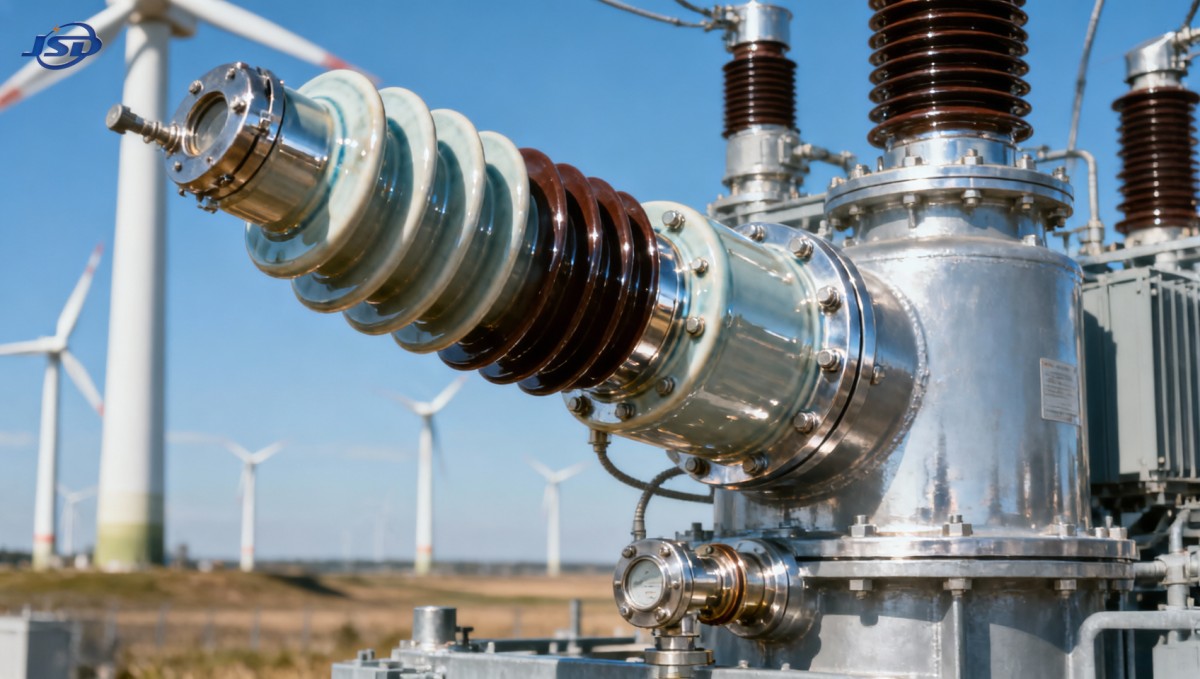
Practical implications for procurement and specification
When drafting tender documents or reviewing bids, avoid vague language like “BIL exceeding IEEE standards.” Instead, specify:
- Minimum lightning impulse level (LIL) and switching impulse level (SIL), referenced to IEC 60076-3 Ed. 4.0 or IEEE C57.12.00-2015 Annex D;
- Mandatory inclusion of full impulse test reports—including waveform capture and pass/fail rationale—not just certification marks;
- Requirement for oil type and its dielectric stability profile under repeated impulse stress (e.g., FR3 vegetable oil, with documented oxidation induction time ≥ 120 hours at 110°C);
- Verification that short-term overload capability (e.g., 150% for ≤2 h) is validated under simultaneous thermal and dielectric stress—not just thermal load testing.
One proven implementation is the 33kV Oil-Immersed Power Distribution Transformer, designed for direct grid connection of renewable energy plants—including wind farms—where its 230 kV BIL, IP65 enclosure, and copper-wound construction align with the surge resilience and environmental durability required at the turbine interface. Its validation across over 50 countries includes deployments in lightning-prone mountainous wind corridors, confirming that the 15% margin translates into measurable field reliability—not just paper compliance.
Ultimately, the 15% impulse test uplift signals a shift in expectation: from treating the step-up transformer as a passive voltage converter to recognizing it as an active surge management node. For technical evaluators, that changes the evaluation lens—from “does it meet the standard?” to “does its insulation system survive the surges it will *actually* see?” That distinction separates durable integration from costly, premature replacement.
Hot News
- 00
0000-00
How U.S. DOE efficiency rules affect distribution transformer manufacturers - 00
0000-00
How american type pad mounted transformer seismic qualification affects installation in California utility grids? - 00
0000-00
Do european compact substation transformer EMC compliance tests include conducted emissions up to 30MHz?
0000-00
Contact Us

Get a Quote
Regardless of whether you require general advice or specific support, we are happy to help you.
Send Us Your Inquiry Today

Jinshida Electric remains committed to contributing to global energy development through professional manufacturing and superior service.