





What Makes a High Efficiency Transformer Worth the Higher Initial Cost?
What Makes a High Efficiency Transformer Worth the Higher Initial Cost?
For many buyers, a transformer quote becomes a simple comparison exercise too early. Rated capacity looks similar, voltage class matches the project, and one option is clearly cheaper. At that point, the higher price of a high efficiency transformer can seem difficult to justify. But that view usually focuses on purchase price alone, while the transformer itself will affect energy loss, maintenance exposure, thermal performance, and operating stability for years.
That is why experienced decision-makers rarely ask only, “How much does it cost?” A more useful question is, “What will it cost to own and operate?” In facilities where equipment runs continuously, even modest differences in no-load loss and load loss can accumulate into meaningful expenses over the transformer’s service life. If the application involves industrial production, grid support, renewable energy integration, or infrastructure with limited tolerance for downtime, the economics become broader than electricity alone.
A high efficiency transformer earns its premium when it reduces long-term waste without introducing new risks. That sounds obvious, but in practice it depends on design details, operating conditions, and whether the specification actually fits the project rather than just looking good on paper.
Where the extra cost usually comes from
The higher initial cost is not arbitrary. In most cases, it reflects better core materials, more optimized winding design, tighter manufacturing control, and stricter attention to heat management. Lower losses are usually achieved by reducing magnetic and resistive waste. That may require higher-grade silicon steel or other core improvements, better conductor sizing, more precise assembly, and insulation systems that support reliable operation under thermal stress.
Those improvements are not equally valuable in every project. If a transformer runs intermittently and lightly loaded, the return on higher efficiency may be slower. If it serves a heavily used industrial line, data center support system, large building complex, or renewable energy interface with long operating hours, the payback picture changes. The cost difference at procurement stage starts to look smaller once losses are translated into annual operating expense.
This is also where misunderstandings often appear. Some buyers assume efficiency is a single number that can be compared in isolation. It is not that simple. Efficiency changes with load profile, ambient conditions, installation method, and the balance between no-load and load losses. A transformer with lower total losses under one operating scenario may not be the best economic choice under another.
Why lifecycle cost matters more than purchase price
Transformers are long-life assets. Once installed, they tend to remain in service far longer than many other pieces of electrical equipment. That alone changes how procurement should be evaluated. A lower upfront price can be misleading if the unit consumes more energy year after year, runs hotter, or creates a higher risk of insulation aging.
In practical terms, the ownership cost usually includes at least four layers: acquisition, energy loss, maintenance or inspection burden, and operational consequence if the transformer underperforms. For some projects, there is also a fifth layer: compliance. Depending on market and application, purchasers may need to consider local efficiency regulations, utility requirements, fire safety expectations, or installation restrictions. These do not always show up in the first quotation comparison, but they can affect redesign cost, approval timelines, and replacement risk later.
A high efficiency transformer tends to make the most sense when electricity cost is significant, utilization is steady, and the operator values predictable thermal behavior. Lower losses mean less wasted power converted into heat. Less heat generally supports insulation life and can reduce stress on surrounding systems such as ventilation in enclosed installations. The financial benefit should still be calculated project by project, but the logic is straightforward: if the transformer works hard for a long time, efficiency has more time to pay you back.
Efficiency is not only about the utility bill
One of the more expensive mistakes in transformer procurement is treating efficiency as an energy-only topic. In reality, thermal performance and reliability are closely linked. Excess loss becomes heat, and excess heat accelerates aging. Over time, this can influence insulation condition, component stress, and overall service stability.
That matters even more in sectors where interruption cost is high. Manufacturing lines, renewable energy sites, transportation-related infrastructure, and commercial facilities with dense loads often care less about the theoretical lowest capital expense than about avoiding avoidable shutdowns. A transformer that runs cooler and more consistently under expected load may help reduce operational uncertainty, even if the nameplate capacity is not unusual.
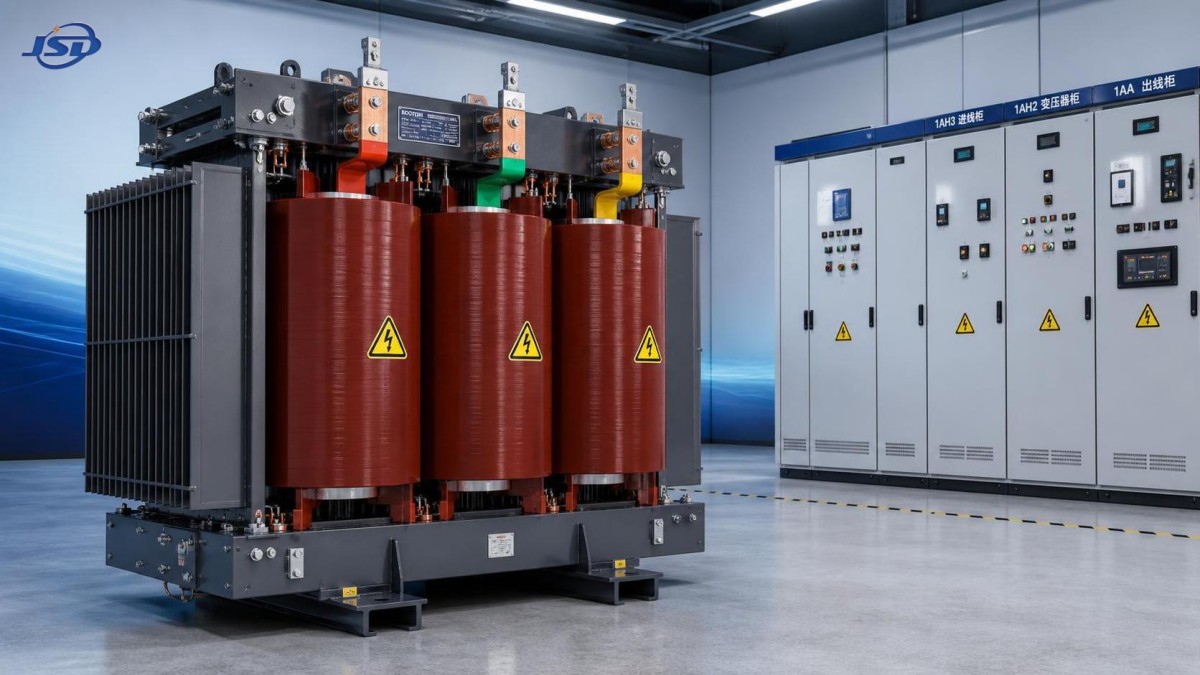
Mid-voltage applications are a good example. In some indoor or fire-sensitive environments, buyers may lean toward dry-type solutions rather than oil-filled alternatives. In that context, a product such as the 35kV Three-Phase Cast Resin Dry-Type Distribution Transformer may enter the discussion not because it is “premium” in a marketing sense, but because the installation conditions, safety priorities, and maintenance expectations make that configuration more suitable. The right value comes from fit, not from label.
Companies with real manufacturing depth usually understand this distinction. Jinshida Electric Power Technology Co., Ltd. focuses on the research, manufacturing, and application of transmission and distribution equipment, and that kind of background matters because transformer selection often depends on how design, process control, and application knowledge come together. A supplier that can discuss loss control, production consistency, and actual use scenarios is generally more useful than one that only competes on nominal price.
What buyers should examine before paying the premium
Paying more only makes sense if the efficiency claim translates into measurable project value. That means buyers should look beyond sales language and ask a few grounded questions.
- What are the specified no-load and load losses, and under which standard or testing basis are they stated?
- What is the expected load profile of the installation? A lightly loaded backup transformer and a continuously loaded production transformer should not be judged the same way.
- What ambient temperature, altitude, cooling conditions, and enclosure constraints will affect real operating efficiency?
- Is the design optimized for the target duty, or is it a generic offering with attractive headline efficiency?
- What are the consequences of higher operating temperature, whether in maintenance, insulation life, or adjacent equipment conditions?
These questions sound technical, but they are really commercial questions in disguise. If the supplier cannot explain how efficiency was achieved, how the design behaves under your operating conditions, or how the loss profile aligns with your load pattern, then the premium may not be well justified.
The risk of buying cheap in the wrong place
Not every lower-cost transformer is a poor choice. Sometimes the simpler option is perfectly adequate. The problem appears when buyers remove cost from one line item and unknowingly add it elsewhere. A unit with higher losses may increase energy expenditure. A design with narrower thermal margin may age faster in harsh service. A product that looks acceptable in a quotation stage may become harder to maintain, replace, or certify once the project is underway.
This is especially relevant in export projects and multi-market procurement. Requirements can vary across utilities, industrial users, and infrastructure investors. Documentation expectations, test requirements, and installation norms may differ. A capable manufacturer with a professional technical team and a rigorous quality management system is often better positioned to support these differences before they become delays. Jinshida Electric’s emphasis on safe, energy-efficient, and high-performance power products reflects the reality that a transformer is rarely purchased as a standalone object; it has to work inside a wider power system and project schedule.
When the premium is easier to justify
In procurement terms, the premium for a high efficiency transformer is usually easier to defend under several conditions: the transformer will run continuously, energy prices are material, the project has a long intended service period, heat dissipation is a design concern, or downtime would be expensive. New energy and infrastructure projects often fall into this category because long-term operating stability matters as much as installed capacity.
The premium is harder to justify when utilization is low, service duration is uncertain, or the transformer is oversized relative to actual demand. Oversizing is a common procurement issue. Buyers sometimes assume more capacity automatically creates safety, but in some cases it can distort the loss picture and weaken the economic case for a more efficient unit. Matching the transformer to the real load profile is often more valuable than simply choosing the highest specification available.
This is also why product selection should not be separated from application discussion. A solution like the 35kV Three-Phase Cast Resin Dry-Type Distribution Transformer may be appropriate in one project because indoor installation, fire behavior, or maintenance strategy makes dry-type technology more attractive. In another project, a different configuration may provide better economics. The point is to compare total fit, not just unit price.
A better way to make the buying decision
If you are deciding whether the higher upfront cost is worth it, build the comparison around expected operating years, load pattern, loss values, installation environment, and reliability consequence. Even a simple internal model can be more useful than a price-only ranking. Many procurement teams already do this for motors and HVAC systems; transformers deserve the same treatment because they are silent cost carriers over a long period.
The most credible suppliers will help with that evaluation rather than avoid it. They should be able to discuss manufacturing process control, design trade-offs, and application suitability in practical terms. For companies serving grid construction, industrial manufacturing, renewable energy, and infrastructure, that conversation is often where real value appears. It is one thing to promise efficiency; it is another to connect efficiency with stable and reliable power support in the actual project context.
A high efficiency transformer is worth the higher initial cost when its lower losses, better thermal behavior, and stronger operating consistency align with how the asset will really be used. If that alignment is missing, the premium may be difficult to recover. Before moving forward, it is worth confirming the loss data, duty cycle, installation constraints, required standards, and expected delivery conditions. Those details usually tell you far more than the first price on the quote sheet.

Get a Quote
Regardless of whether you require general advice or specific support, we are happy to help you.
Send Us Your Inquiry Today

Jinshida Electric remains committed to contributing to global energy development through professional manufacturing and superior service.