





Power Transformer Manufacturer Warranties: Coverage, Exclusions, and Claims
A power transformer warranty can protect your investment—but only if its terms match your project’s operational risks. For procurement teams evaluating an electrical power transformer manufacturer, warranty length is just the starting point. Manufacturing-defect coverage, installation exclusions, and responsibility for transport, labor, and replacement costs can all change the real value of an offer.
The uncomfortable moment usually comes after a fault: the supplier agrees to repair the transformer, but nobody has agreed who pays for the crane, temporary power, or international freight. This guide explains how to compare warranty provisions, close contractual gaps, and prepare a claim before those unanswered questions become urgent.
A longer warranty is not necessarily a better warranty
Two quotations may both advertise a “24-month warranty” while offering very different protection. One might start at shipment and cover factory repairs only. Another might start at commissioning, subject to a delivery-based deadline, and include approved on-site work. For a project with a long construction schedule, that difference matters.
Read the warranty as an allocation of risk, not a headline benefit. Establish these points before comparing suppliers:
- Start date: Does coverage begin at dispatch, delivery, acceptance, or commissioning?
- Outside limit: Is there a maximum period after shipment, regardless of when commissioning occurs?
- Covered equipment: Are bushings, tap changers, gauges, protective devices, and other supplied accessories included?
- Available remedy: Can the manufacturer choose repair, replacement, or another contractual remedy?
- Cost responsibility: Who pays for diagnosis, removal, freight, reinstallation, testing, and return to service?
- Claim conditions: What notification deadlines, maintenance records, and approval procedures apply?
Also check the order of precedence between the purchase contract, technical agreement, quotation, and standard warranty document. A negotiated provision has limited practical value if another document overrides it.
What power transformer manufacturer warranties usually cover
Manufacturer warranties commonly address defects in materials and workmanship under specified installation, operation, and maintenance conditions. Depending on the agreement, examples may include defective winding construction, manufacturing-related insulation faults, faulty welds, or improperly assembled components. These are potential claim categories—not automatic findings of manufacturer responsibility.
The cause of failure remains central. A leaking seal may reflect defective assembly, transport damage, unsuitable storage, or intervention during installation. The same visible symptom can lead to different contractual outcomes.
Keep performance guarantees separate from defect coverage
A transformer can operate without failing and still miss a contractual requirement. No-load losses, load losses, impedance, temperature rise, and sound levels should be addressed through agreed technical guarantees and acceptance criteria where relevant.
For example, specifying IEC 60076 does not by itself establish warranty duration, reimbursement obligations, or every project-specific performance limit. Identify the applicable parts and editions, required tests, acceptable tolerances, and consequences of nonconformance in the contract. Do not assume a general promise of “high efficiency” creates an enforceable loss guarantee.
Exclusions: where project conditions need closer attention
Exclusions are not inherently unreasonable. A manufacturer cannot control every site event. The purchasing risk lies in wording so broad that almost any failure can be attributed to operating conditions without a clear technical basis.
Common areas to examine include:
- Overloading and abnormal electrical conditions: Operation beyond agreed ratings, excessive harmonics, overvoltage, or external short-circuit events may be excluded. Define the intended duty and system conditions during specification.
- Incorrect installation: Improper connections, grounding, handling, or commissioning may affect coverage. Obtain written installation instructions and clarify supervision requirements.
- Unsuitable environment: Ambient temperature, altitude, corrosion, flooding, and ventilation can influence suitability. Disclose actual site conditions rather than relying on a standard configuration.
- Inadequate maintenance: Missing inspections or failure to address oil leakage may complicate a claim. Ask for maintenance requirements before ordering.
- Unauthorized modification or repair: Component changes and third-party work may require prior written consent.
- External damage: Lightning, fire, accidents, and handling damage may require separate insurance protection.
For renewable energy projects, discuss fluctuating loads, harmonics, and expected operating cycles. For industrial parks, disclose significant load disturbances. The goal is to have foreseeable service conditions accepted in writing, not merely discussed during a sales call.
Where possible, negotiate that an exclusion applies to damage caused by the excluded condition rather than automatically voiding all coverage. The enforceability of such wording depends on the governing contract and applicable law.
The hidden cost is often outside the transformer
A “free repair” can still leave the owner with a substantial bill. Removing an oil-immersed unit may require isolation, lifting equipment, oil containment, specialist labor, and transport. Reinstallation introduces further testing and coordination costs. Meanwhile, the site may need temporary supply.
When comparing quotations, separate costs into three groups:
- Repair costs: Replacement parts, workshop labor, and factory testing.
- Recovery costs: Site diagnosis, dismantling, oil handling, cranes, freight, reinstallation, and recommissioning.
- Business interruption costs: Temporary power, lost production, project delay, and associated commercial losses.
Do not assume the warranty covers all three. Commercial terms often limit liability or exclude consequential losses; treatment varies by agreement and jurisdiction. Ask specifically how temporary power and downtime are addressed, and consider insurance or operational contingency planning for costs the supplier does not accept.
A useful comparison is:
Procurement cost exposure = purchase price + planned lifecycle costs + retained failure-related costs.
This is a decision framework, not a prediction of failures. If reliable reliability data are unavailable, compare scenarios instead: an approved on-site repair, a factory return, and replacement requiring extended downtime. Identify which party pays each cost in each scenario.
Match the warranty to the transformer you are actually buying
Different transformer designs create different procurement priorities. For continuously energized distribution equipment, no-load losses can materially affect operating expenditure. That makes verified loss performance important alongside defect coverage.
Jinshida Electric Power Technology Co., Ltd.’s SBH15 Amorphous Alloy Transformer is relevant to this discussion because its amorphous alloy core is designed to reduce no-load losses compared with conventional silicon steel core designs. The supplied product information also describes copper windings and an oil-immersed insulation structure, with applications including distribution networks, commercial buildings, and energy-saving retrofit projects.
The accompanying technical information identifies an SH15-series configuration with capacities from 30 kVA to 2500 kVA, ONAN cooling, and 50 Hz or 60 Hz options. Buyers should confirm the exact model designation, voltage combination, and ordered configuration in the quotation and technical agreement rather than treating all listed options as interchangeable.
For this type of purchase, request guaranteed loss values, relevant test reports, agreed sound limits where needed, and oil-system inspection instructions. Low-loss construction supports the efficiency objective; it does not establish the warranty terms. Duration, exclusions, and claims support must still be confirmed separately.
Jinshida Electric focuses on the R&D, manufacturing, and application of power transmission and distribution equipment. Its stated emphasis on technical capability and quality management provides a basis for supplier discussions, but procurement should verify project-specific documentation and contractual commitments rather than infer warranty protection from a company profile.
Prepare the claim file before the first energization
The strongest claim file starts at delivery, not after failure. Assign responsibility for receiving inspection, commissioning records, and maintenance documentation while the project team is still organized.
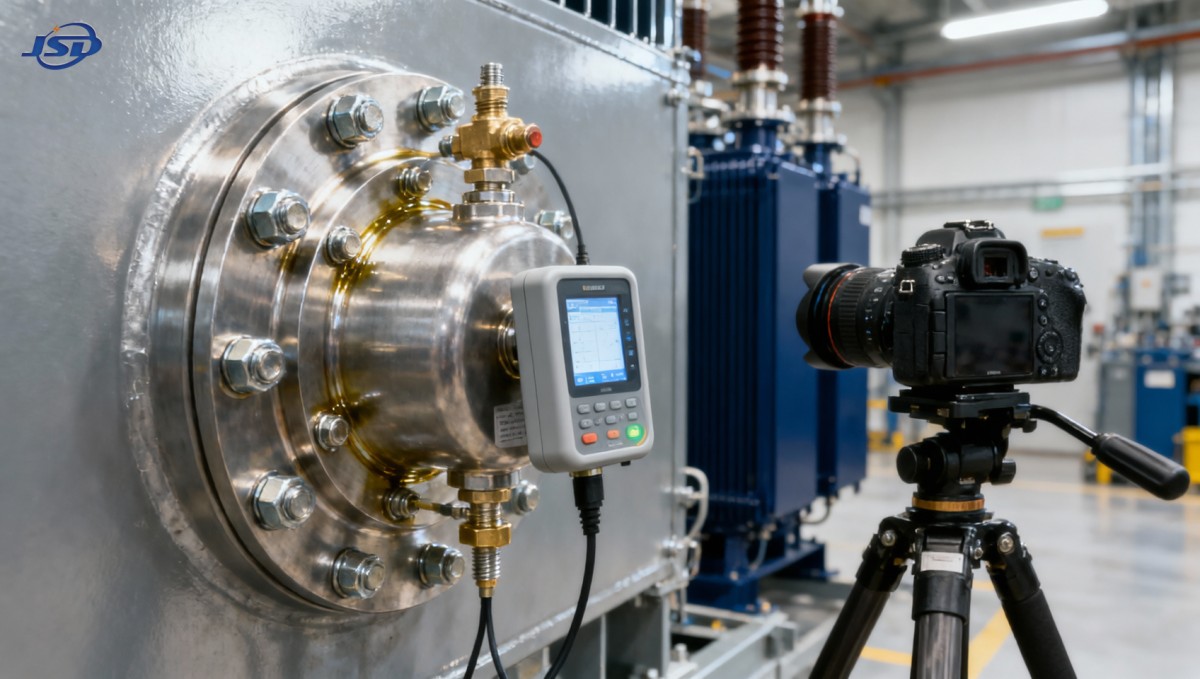
Retain the purchase agreement, approved drawings, serial numbers, factory test reports, delivery inspection records, storage history, installation records, and commissioning results. For oil-immersed equipment, preserve applicable oil test results and records of oil handling. Date photographs so the equipment’s condition can be traced.
If a fault occurs, follow a controlled sequence
- Make the site safe. Qualified personnel should isolate and assess the equipment under site safety procedures. Do not re-energize a suspected faulty transformer simply to reproduce the problem.
- Notify the supplier promptly. Use the required channel and identify the unit, event time, symptoms, and operating conditions. Observe contractual reporting deadlines.
- Preserve evidence. Save relay records, alarms, loading history, photographs, and available monitoring data. Avoid unnecessary dismantling that could obscure the cause.
- Agree on the investigation. Confirm authorized tests, sampling procedures, site attendance, and handling of removed components.
- Obtain written repair instructions. Clarify permitted work, cost authorization, transport arrangements, and the provisional restoration schedule.
- Document closure. Record findings, corrective work, post-repair tests, cost allocation, and the remaining warranty status.
If urgent action is necessary to protect people or equipment, document why it could not wait and contact the manufacturer as soon as practicable. Safety takes priority, but clear records help prevent later disputes over emergency intervention.
Questions worth resolving before the purchase order
A short, written clarification request can reveal more than a lengthy warranty brochure. Ask your shortlisted electrical power transformer manufacturer:
- Can delayed commissioning reduce the usable warranty period, and is an extension available?
- Are storage requirements and inspection intervals supplied before shipment?
- Who authorizes local repairs, and who pays the approved contractor?
- What response commitments apply to acknowledgment, diagnosis, and corrective action?
- Who bears freight, insurance, customs charges, and site handling for a warranted return?
- Does repaired or replaced equipment receive a new warranty period or only the remaining original period?
- How are disputed failure causes reviewed, and can an independent expert be appointed?
- What spare-parts support is available after warranty expiry?
Distinguish an acknowledgment deadline from a repair deadline. A supplier may respond quickly while replacement components still require manufacturing and transport. For critical sites, a spare-unit strategy or approved local service arrangement may provide more resilience than additional warranty months alone.
The best purchasing decision is not the offer with the longest warranty headline. It is the offer that makes coverage, exclusions, evidence requirements, and financial responsibility understandable before a fault occurs. Resolve those details alongside technical specifications, and the warranty becomes a practical part of lifecycle cost control—not a promise you have to interpret during an outage.

Get a Quote
Regardless of whether you require general advice or specific support, we are happy to help you.
Send Us Your Inquiry Today

Jinshida Electric remains committed to contributing to global energy development through professional manufacturing and superior service.