





How energy efficient distribution transformer total ownership cost compares over 20 years with standard units
When evaluating long-term value, an energy efficient distribution transformer delivers far more than upfront savings—it slashes lifetime operational costs by up to 30% over 20 years compared to standard units. This isn’t theoretical: the difference emerges from how losses compound across decades of continuous operation. Unlike one-time capital expenditure, transformer losses—both no-load (core) and load (copper)—convert directly into heat, requiring constant energy input without delivering usable output. Over a 20-year service life, even modest differences in efficiency translate into tens of thousands of kilowatt-hours wasted—and corresponding cost burdens that scale with local electricity tariffs, loading profiles, and ambient temperature conditions.
Standard distribution transformers typically meet minimum regulatory thresholds—such as DOE 2016 or IEC 60076-1—designed for baseline compliance, not optimal lifecycle economics. These standards set upper limits on losses but do not incentivize performance beyond them. As a result, many standard units operate at loss levels that remain technically acceptable yet economically suboptimal under real-world duty cycles. For example, a 100 kVA unit with 350 W no-load loss and 1,410 W load loss at full rating will consume approximately 15,700 kWh annually just in core losses alone—even if idle 40% of the time. That’s equivalent to powering three average U.S. households for a year, solely due to magnetic hysteresis and eddy currents in the core.
Energy efficient distribution transformers narrow this gap through material-level and geometric precision. High-quality cold-rolled grain-oriented silicon steel sheets—processed with controlled cutting, stacking, and annealing—reduce no-load current and magnetic flux leakage. When combined with mineral oxide insulation and tight interlaminar coating, they lower excitation losses without compromising dielectric integrity. Similarly, low-voltage foil winding improves current distribution uniformity and reduces stray losses under harmonic-rich loads common in agricultural production or civil building power supply and distribution systems. These aren’t incremental improvements; they shift the entire loss curve downward across partial-load conditions where most distribution units spend >70% of their operational life.
Consider thermal aging: every 8°C rise above rated operating temperature halves insulation life. Standard units running at higher loss levels generate more internal heat, accelerating degradation of A-E grade insulation materials. Over two decades, this can compress effective service life from the theoretical 30 years down to 18–22 years—triggering unplanned replacement, grid downtime, and secondary costs like labor, crane rental, and outage compensation. In contrast, optimized core geometry and improved cooling design in high-efficiency models maintain lower hotspot temperatures even under sustained overloads—a critical factor in suburban distribution networks facing increasing EV charging demand.
The total ownership cost (TOC) model must therefore include five non-negotiable components: initial purchase price, installation labor and logistics (including pole-mounting hardware and site preparation), energy losses over projected load profile, maintenance frequency (driven largely by thermal stress and oil degradation rate), and end-of-life disposal or recycling obligations. While initial cost differences between standard and high-efficiency units range from 12% to 22%, the energy component dominates TOC after Year 3 in nearly all commercial and industrial applications with annual operating hours exceeding 4,000. A comparative analysis using typical North American and EU residential/commercial load curves shows breakeven occurring between 3.7 and 5.9 years—well within the first quarter of the asset’s life.
Real-world variability matters. Loss savings are not linear across capacity tiers. A 50 kVA unit may achieve only 18% TOC reduction over 20 years, while a 167 kVA unit sees 27–30%—not because of scaling alone, but because larger units operate closer to nameplate ratings more consistently, magnifying the impact of per-watt loss reductions. Likewise, location-specific factors alter ROI: units deployed in hot, humid climates experience accelerated oil oxidation, making low-loss designs doubly valuable—not just for energy savings, but for extended oil service intervals and reduced dissolved gas analysis (DGA) frequency.
One often-overlooked variable is voltage regulation stability under fluctuating loads. High-efficiency designs frequently incorporate tighter impedance control and optimized tap changer coordination. This minimizes secondary voltage swing during motor startups or photovoltaic export surges—reducing stress on connected equipment and avoiding nuisance tripping in rural and urban power distribution settings. It’s not just about watts saved; it’s about maintaining waveform fidelity and system resilience across diverse applications including agricultural production and civil building power supply and distribution systems.
Specifications like “customizable frequency” or “customizable connection group” reflect functional flexibility—but they don’t reduce losses unless implemented with loss-conscious design intent. For instance, a delta-wye configuration may lower zero-sequence impedance, but if achieved via asymmetrical winding placement or compromised core window utilization, it can increase stray losses by 5–9%. True efficiency requires holistic integration: core material selection, winding geometry, tank shielding, and even bushing placement must be co-optimized—not treated as independent variables.
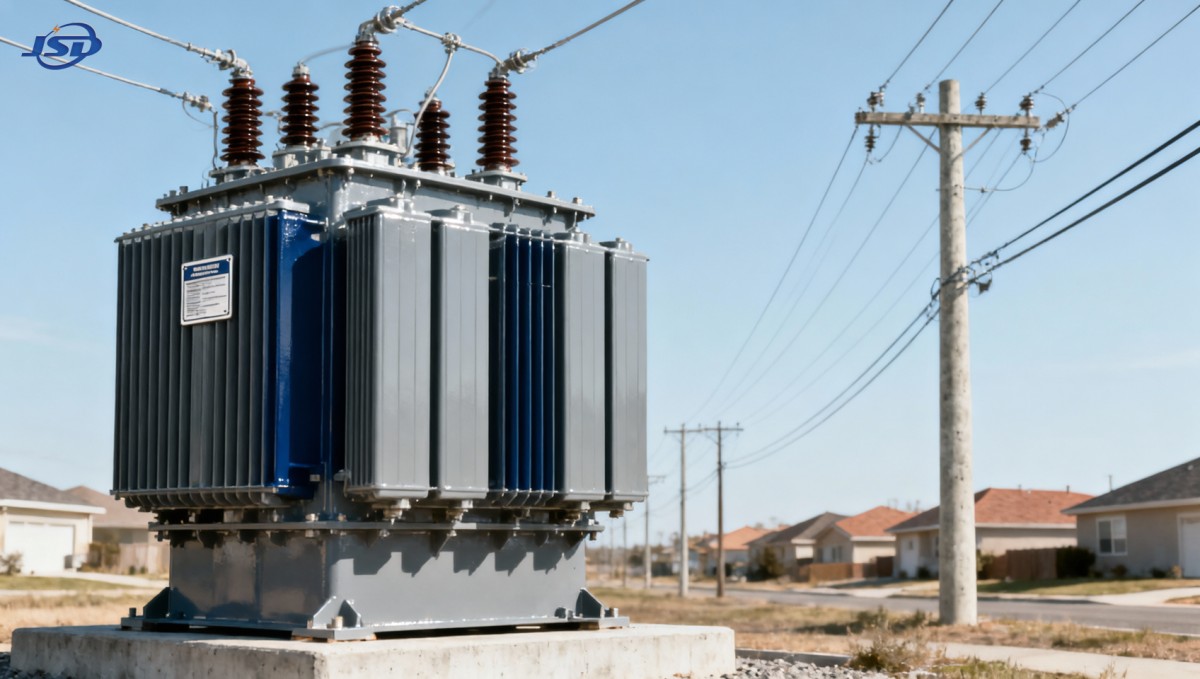
A practical example illustrates this: the Pole-Mounted Oil-Immersed Single-Phase Transformer uses high-voltage copper wire winding technology to improve lightning resistance performance while preserving low-loss characteristics. Its compact & lightweight form factor—evident in dimensions like WDH 59093510mm for the 100 kVA variant—is achieved not by thinning conductors or reducing insulation thickness, but by optimizing magnetic path length and utilizing high-permeability core laminations. The result is verified performance better than ANSI/IEEE C57 and IEC 76 requirements, with measured no-load losses as low as 197 W (for 5 kVA) and load losses of 205 W (at 10 kVA), validated across more than 50 countries and regions.
Installation method also influences lifetime cost. Pole-hanging installation introduces mechanical vibration and thermal cycling stresses distinct from pad-mounted or substation deployments. Units designed for this environment require reinforced clamping systems and damping features that prevent core displacement—because even micrometer-level movement degrades interlaminar insulation and increases no-load loss over time. That’s why process control in cutting and stacking silicon steel sheets isn’t a manufacturing footnote—it directly determines long-term loss stability, no-load current consistency, and audible noise levels—all of which affect both regulatory compliance and community acceptance in sensitive locations.
Finally, sustainability commitments increasingly tie into procurement criteria—not as marketing add-ons, but as enforceable contract clauses. Energy efficient distribution transformers support measurable Scope 2 emissions reduction, aligning with corporate net-zero roadmaps. But credibility hinges on verifiable test reports, not datasheet claims. Look for units certified to KEMA, CB, or UL/cUL with third-party loss validation at multiple load points—not just nameplate-rated conditions. And remember: a transformer rated for 36 kV maximum voltage doesn’t guarantee low-loss behavior at 12.47 kV primary—design optimization must match actual system voltage, not just maximum tolerance.
Over 20 years, the difference between “compliant” and “optimized” isn’t abstract. It’s reflected in meter readings, maintenance logs, replacement schedules, and carbon reporting statements. Choosing based on TOC means treating the transformer not as static infrastructure, but as a dynamic energy conversion asset—one whose physics, materials, and application context jointly define its true economic lifespan.

Get a Quote
Regardless of whether you require general advice or specific support, we are happy to help you.
Send Us Your Inquiry Today

Jinshida Electric remains committed to contributing to global energy development through professional manufacturing and superior service.