





Capacity Planning Risks When Buying Large Substation Transformers
Buying a high capacity substation transformer involves more than selecting the right voltage rating and nameplate capacity. For procurement teams, overlooked planning risks—site constraints, grid compatibility, manufacturing lead times, testing obligations, and lifecycle costs—can delay critical projects and increase total investment. The transformer itself may be one of the largest line items in a substation package, but the more expensive mistakes often appear around it: a unit that cannot be transported to site, an impedance value that does not suit the protection study, or a factory test plan that is agreed too late.
A sound purchasing decision therefore starts before quotations are compared. The buyer needs a workable view of the electrical system, the physical route to installation, the local utility requirements, and the commercial consequences of delay. This is especially relevant for grid expansion, industrial plants, renewable-energy interconnection, large commercial facilities, and infrastructure projects where energization dates are tied to wider construction milestones.
Capacity is not the same as usable capacity
The first risk is treating MVA rating as the whole specification. A transformer selected only for today’s calculated peak load may have little margin for seasonal demand, future production lines, motor starts, harmonic-producing equipment, generation export, or contingency operation. Conversely, procuring a substantially oversized unit can raise acquisition cost, increase no-load losses, complicate protection coordination, and leave capital tied up in capacity that may not be needed.
A capacity plan should distinguish between normal loading, emergency loading, and credible future demand. It should also identify whether the substation will operate with one transformer, parallel transformers, or a standby arrangement. These choices affect not only the rating but also bus configuration, breaker duties, relay settings, and the acceptable loss of supply during maintenance. The practical question is not simply, “How many MVA do we need?” It is, “What load must remain served under each operating condition, and for how long?”
Thermal assumptions deserve the same attention. Ambient temperature, altitude, cooling method, and loading profile all influence the usable rating. Procurement documentation should state the intended service conditions rather than assuming a standard temperature rise will fit every location. If an overload requirement is important, it needs to be defined alongside monitoring expectations, cooling arrangements, and the owner’s operating philosophy. A brief peak may be manageable; repeated overloads are a different planning decision.
Electrical compatibility can reshape the purchase
A high capacity substation transformer sits inside a network, not in isolation. The offered voltage ratio must align with the actual utility supply and downstream distribution arrangement, but several less visible parameters can be equally decisive. Vector group, tap range and tap-changer duty, impedance, insulation level, neutral grounding arrangement, and short-circuit withstand capability should be reviewed against the single-line diagram and available system studies.
Impedance is a frequent source of late-stage difficulty. It affects fault current and voltage regulation and becomes particularly sensitive where transformers will operate in parallel. A seemingly attractive alternative proposal may have an impedance outside the acceptable range for the planned protection scheme. Changing relays, breakers, or busbar ratings after transformer selection can cost far more than resolving the issue during technical evaluation.
The same caution applies to renewable-energy projects and sites with power-electronic loads. Inverters, drives, rectifiers, and rapidly varying loads can change the harmonic and voltage-performance picture. Buyers do not need to prescribe a design solution without engineering input, but they should require suppliers to identify the operating data needed for a suitable design. This is preferable to accepting generic wording that a transformer is “suitable for industrial use.”
For a large transformer feeding several lower-voltage areas, procurement should also consider the downstream package rather than optimizing each unit separately. A 20 kV to 0.4/0.415 kV distribution transformer, for example, may be part of the final step between a primary substation and plant loads, public facilities, or renewable auxiliaries. Options such as the 20kV/0.4kV Oil-Immersed Power Distribution Transformer cover ratings from 50 kVA to 5,000 kVA and can be relevant where distribution capacity needs to be phased alongside a larger substation investment.
The site and transport route are part of the specification
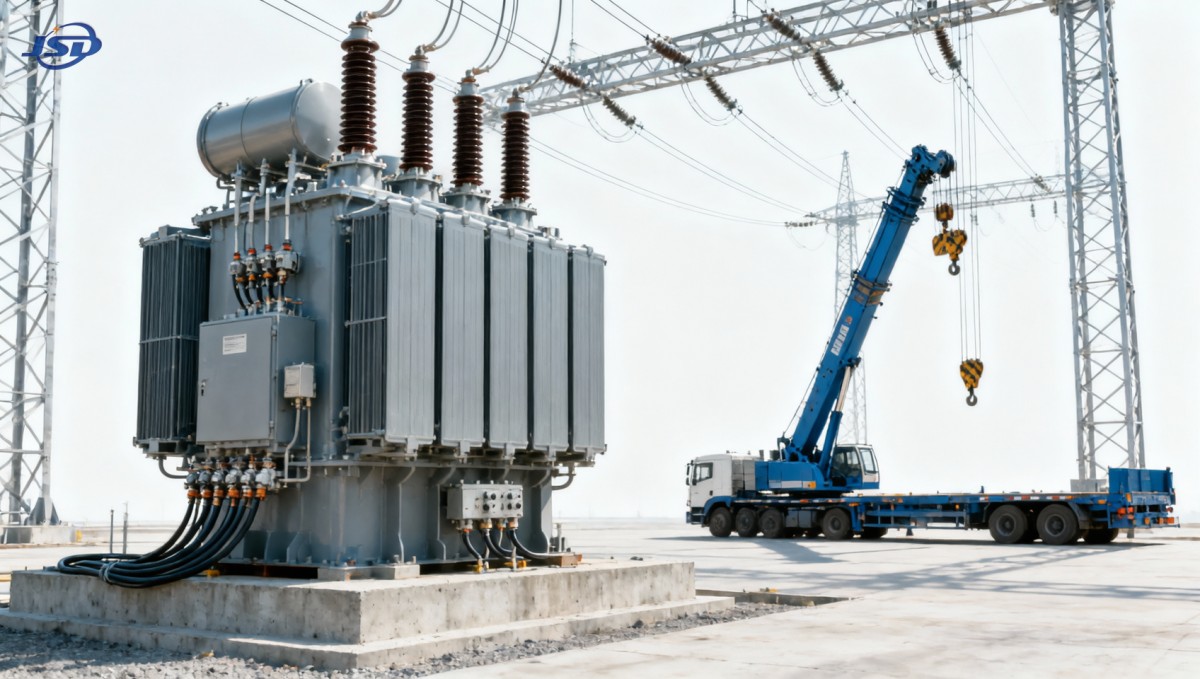
Large transformers are often purchased before the physical delivery route has been fully verified. That creates avoidable exposure. Total shipping dimensions and mass may differ from the dimensions of the active part, while transport weight can vary depending on whether accessories, bushings, radiators, or oil are shipped separately. Bridges, road turning radii, gate widths, overhead obstructions, crane reach, foundation access, and temporary lifting arrangements all need early confirmation.
At the substation, clearances for radiators, conservators, cable boxes, fire barriers, access roads, and maintenance work are not secondary details. A compact arrangement can be valuable, but only if it still permits installation, inspection, and safe replacement of components. Where fire risk, water-protection requirements, or a restricted indoor location applies, the insulating-fluid choice and containment design should be discussed before the technical specification is frozen. FR3 vegetable oil may be considered in suitable applications, but its selection should follow the project’s fire, environmental, and operational requirements rather than a general preference.
Procurement teams should ask for a preliminary general arrangement drawing early enough to test these interfaces. It is much easier to revise a layout before civil works are complete than to modify foundations or fencing after a transformer has entered production.
Lead time risk is usually an information-management problem
The delivery date quoted for a power transformer is meaningful only when the technical scope is stable. Long-lead components, special bushings, on-load tap changers, protection equipment, testing slots, and export documentation can all influence the final schedule. A supplier may be able to manufacture the main tank within a certain period, yet the complete project schedule can still be governed by approved drawings, customer comments, witnessed tests, shipping windows, or site readiness.
A useful bid comparison separates “manufacturing completion,” “factory acceptance test readiness,” “ex works availability,” and “delivery to site.” These are not interchangeable milestones. Buyers should also establish how design approvals affect the schedule: how many review cycles are assumed, what constitutes final approval, and whether changes after approval trigger a revised delivery date or cost.
For critical-path substations, a procurement plan should include named responsibilities for interface data. The transformer manufacturer may need final system voltage, fault level, cable or busbar connection details, protection requirements, and transport restrictions. The owner or EPC contractor may need drawings, loading data, foundation loads, oil information, and test documentation by particular dates. A schedule is more reliable when both sides know what must be released and when.
Compare the total cost, not only the bid price
The lowest equipment price can be a poor commercial outcome if losses, service obligations, spares, installation changes, or outage exposure are excluded. Capital cost matters, but procurement should also evaluate no-load and load losses, expected load profile, cooling power, warranty terms, availability of replacement components, and the cost of planned maintenance. The relative importance of these items depends on how continuously the transformer will be energized and how electricity losses are valued by the project owner.
Loss figures should be compared on a like-for-like basis: same rating, cooling class, impedance assumptions, applicable standard, and guaranteed test method. An offer that appears more efficient may not be directly comparable if these conditions differ. Where a project is subject to a particular national or utility efficiency requirement, that requirement should be written into the enquiry rather than inferred from a supplier’s general product range.
The cost of risk also belongs in the evaluation. Does the supplier provide clear deviation lists? Are accessories and monitoring devices included consistently? Is commissioning support defined? What documents will be supplied for customs, insurance, installation, and operation? A quotation with a transparent scope is easier to defend internally than one that looks inexpensive because key responsibilities remain undefined.
A practical evaluation matrix
Testing and documentation should be agreed before production
Factory acceptance testing is not merely a final inspection event. The test scope, applicable standard, witness arrangements, notice period, acceptance criteria, and treatment of nonconformities should be visible in the purchase order. Routine, type, and special tests have different purposes, and not every test applies to every transformer or project. If a purchaser requires a particular test, it should be specified with the relevant standard and commercial responsibility clearly stated.
Document quality matters later, often when site teams are under pressure. Approved drawings, terminal details, wiring diagrams, manuals, oil data, test reports, packing lists, and preservation instructions should be planned as deliverables, not collected at the end. This is especially important where equipment crosses borders or must satisfy a utility’s submission process.
Manufacturers with engineering, manufacturing, and application capability can add value here by challenging unclear inputs early. Jinshida Electric Power Technology Co., Ltd. approaches power transmission and distribution projects through technical coordination, controlled manufacturing processes, and rigorous quality management, supporting applications across grid construction, industry, new energy, and infrastructure. For buyers, the useful measure is not a broad claim of capability but the supplier’s willingness to turn project assumptions into a traceable technical and delivery plan.
Make the award decision resilient
Before issuing an order for a high capacity substation transformer, bring the electrical engineer, civil team, logistics lead, commissioning representative, and commercial owner into the same review. Confirm the parameters that cannot be changed cheaply, identify the documents that release production, and record every accepted deviation. This may take more effort than comparing headline prices, but it prevents the most disruptive surprises from appearing after the supplier has begun work.
The strongest procurement outcome is usually not the transformer with the lowest initial number or the highest stated rating. It is the unit whose duty, interfaces, test requirements, delivery path, and lifecycle obligations have been understood well enough that the project can energize when planned and operate within its intended limits.

Get a Quote
Regardless of whether you require general advice or specific support, we are happy to help you.
Send Us Your Inquiry Today

Jinshida Electric remains committed to contributing to global energy development through professional manufacturing and superior service.