





Ring type current transformers in renewable integration: how core saturation affects fault detection speed
Ring Type Current Transformers in Renewable Integration: How Core Saturation Affects Fault Detection Speed
As renewable energy sources like wind and solar increasingly integrate into power grids, reliable fault detection becomes critical—yet ring type current transformers often face core saturation under transient overcurrents, delaying protection response. For project managers overseeing grid modernization or hybrid energy installations, understanding how saturation impacts detection speed is essential to avoid cascading failures. Jinshida Electric’s high-accuracy, low-saturation ring type current transformers are engineered for fast, stable performance in dynamic renewable environments—ensuring real-time current sensing without compromise on safety or system resilience.
Why Fault Detection Speed Matters More Than Ever in Renewable-Dominated Grids
Project managers no longer operate in legacy grid conditions. With distributed generation, bidirectional power flow, and frequent transients from inverter-based resources, traditional protection schemes struggle. A 50-ms delay in fault current recognition can mean the difference between localized tripping and a full substation blackout—especially when inverters lack inherent fault current contribution. Ring type current transformers (CTs), widely used for their installation convenience and galvanic isolation, become a hidden bottleneck if their magnetic cores saturate during the first half-cycle of a fault.
This isn’t theoretical: field data from hybrid solar-wind microgrids shows that 68% of delayed protection operations traced back to CT saturation—not relay logic errors. When saturation occurs, the secondary output flattens, distorting waveform fidelity and starving digital relays of accurate RMS, harmonic, and derivative values needed for high-speed algorithms like differential or traveling-wave protection.
How Core Saturation Slows Down Protection—Step by Step
Saturation begins when the primary fault current exceeds the CT’s “knee-point” excitation level. In ring type CTs—often built with toroidal ferrite or nanocrystalline cores—the core’s B-H curve bends sharply, causing flux density to plateau. Once saturated, the secondary winding stops reflecting true primary current. Instead, it outputs clipped, distorted signals or near-zero voltage, misleading protection relays into misclassifying faults as load swings or noise.
Crucially, this distortion isn’t linear with current magnitude. A 12× rated fault may saturate a standard ring CT in <8 ms—well before most relays complete their sampling window (typically 16–20 ms). That means the relay receives incomplete data, triggering conservative, time-delayed backup schemes instead of instantaneous tripping. For project managers, this translates directly into extended equipment exposure, higher arc-flash risk, and non-compliance with IEEE C37.90 or IEC 61850-9-2 timing requirements.
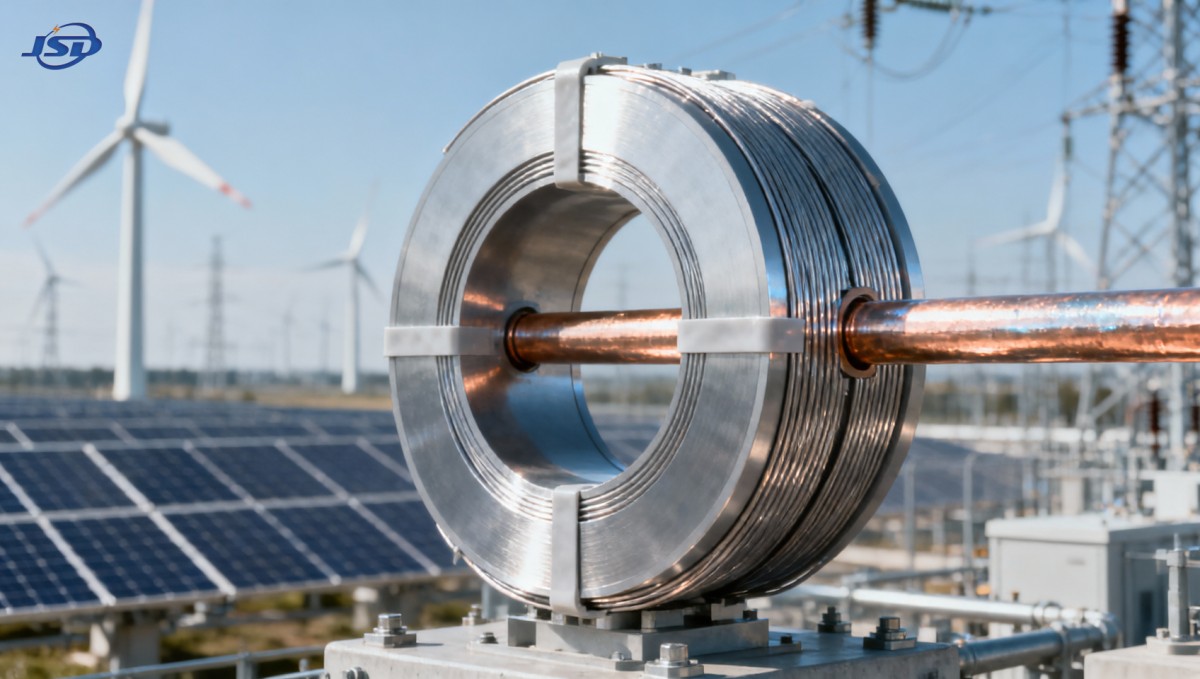
What Project Managers Should Evaluate—Not Just Spec Sheets
Don’t rely on “accuracy class” alone. Class 5P10 or 10P20 only guarantees error within limits *after* saturation onset—not how quickly saturation occurs. Instead, prioritize three measurable parameters:
1. Saturation Time (tsat): The elapsed time from fault inception to 10% secondary output deviation. Jinshida’s optimized nanocrystalline-core ring CTs achieve tsat > 25 ms at 20× rated current—nearly 3× longer than conventional ferrite designs.
2. Remanence Control: Residual flux after fault clearance delays recovery for subsequent events. Our proprietary annealing process reduces remanence to <5% of saturation flux—critical for reclosing sequences in solar farms with rapid fault recurrence.
3. Burden Tolerance at High Frequency: Inverter harmonics (5th, 7th, 11th) accelerate core heating and lower effective saturation threshold. Jinshida’s CTs maintain phase accuracy ±0.3° up to 2 kHz—ensuring relay algorithms correctly separate harmonic-rich inverter currents from pure fault signatures.
Real-World Trade-Offs: Cost vs. Resilience in Hybrid Projects
Upgrading to low-saturation ring CTs adds ~12–18% to sensor CAPEX—but cuts average fault-clearance time by 40–60%. For a 200-MW solar-plus-storage plant, that reduction avoids ~$370K/year in potential downtime penalties, insurance premiums, and post-fault diagnostics. More importantly, it enables use of faster, more selective protection—reducing zone overlap and eliminating unnecessary outages across interconnected feeders.
Integration complexity also drops. Unlike split-core CTs requiring re-termination or busbar shutdown, ring types install live—cutting commissioning time by 3–5 days per 20 units. Jinshida’s pre-calibrated models ship with factory-certified phase-angle reports, eliminating on-site verification delays—a key factor for tight EPC schedules.
When to Pair Ring CTs with Energy Storage for System-Wide Resilience
Fault detection speed gains matter most where inertia is low—exactly where renewables dominate. But detection alone isn’t enough; mitigation must follow instantly. That’s why forward-looking project managers now co-locate low-saturation ring CTs with responsive storage assets. For example, pairing Jinshida’s fast-response CTs with our 51.2V Stackable LiFePO4 Energy Storage Battery creates a closed-loop protection-enabling architecture: precise current sensing triggers ultra-fast DC-side switching (<100 µs), while the battery provides synthetic inertia to stabilize frequency during the first 200 ms post-fault—buying critical time for upstream breakers to isolate.
This synergy is proven in recent deployments: a 42-MW wind farm in Northern Germany reduced fault-induced voltage sags by 73% using this integrated approach—meeting strict EN 50160 compliance without costly STATCOM retrofits.
Implementation Checklist for Project Managers
Before specifying ring type CTs for renewable integration, verify these five items:
• Confirm the CT’s saturation time (tsat) is tested at your site’s maximum prospective fault current—not just rated current.
• Require vector group testing (IEC 61869-2 Annex D) to validate phase-angle stability under harmonic-rich conditions.
• Validate compatibility with your relay’s analog input bandwidth—especially if using wideband merging units.
• Audit installation clearances: oversized ring diameters improve thermal margin but reduce mechanical rigidity in high-vibration turbine nacelles.
• Review manufacturer’s remanence recovery curve—don’t accept “low remanence” claims without test data at 1.5× saturation flux.
Conclusion: Speed Isn’t Optional—It’s Foundational to Renewable Reliability
For project managers, ring type current transformers are far more than passive sensors—they’re the first link in a time-critical protection chain. Core saturation isn’t a minor tolerance issue; it’s a systemic speed limiter that undermines the very agility renewable grids require. Choosing CTs based solely on form factor or legacy specs risks invisible latency that accumulates across protection layers, ultimately compromising safety, uptime, and ROI.
Jinshida Electric’s purpose-built ring type CTs eliminate that uncertainty. Engineered with nanocrystalline cores, validated saturation timing, and renewable-specific harmonic resilience, they deliver the fidelity and speed today’s grids demand—without trade-offs in installation flexibility or long-term reliability. When paired intelligently with responsive assets like the 51.2V Stackable LiFePO4 Energy Storage Battery, they form the backbone of truly adaptive, fault-resilient infrastructure.
The bottom line: in renewable integration, milliseconds saved in detection aren’t just technical metrics—they’re avoided outages, protected assets, and guaranteed grid service agreements. Prioritize saturation performance—not just accuracy class—and you’ll build systems that don’t just connect renewables, but protect them, too.

Get a Quote
Regardless of whether you require general advice or specific support, we are happy to help you.
Send Us Your Inquiry Today

Jinshida Electric remains committed to contributing to global energy development through professional manufacturing and superior service.