





Oil-Immersed Medium Voltage Transformers: When Outdoor Installation Is the Better Fit
Oil-Immersed Medium Voltage Transformers: When Outdoor Installation Is the Better Fit
For a project manager, transformer selection is rarely just a comparison of nameplate ratings. The real decision affects civil works, cable routing, fire planning, maintenance access, outage exposure, delivery sequencing, and the operating budget long after commissioning. In outdoor substations, industrial plants, solar facilities, and infrastructure schemes, an oil immersed medium voltage transformer often remains the practical choice when capacity, thermal performance, and long service life matter more than the compact footprint of an indoor installation.
That does not mean oil-filled equipment is automatically right for every site. Dry-type transformers can be a stronger option where indoor fire constraints, restricted access, or building integration dominate the design. But when a project has adequate outdoor space and the site conditions are properly addressed, oil immersion offers advantages that are difficult to ignore—particularly on higher-load distribution duty where heat must be removed reliably through long summer afternoons, uneven renewable generation, or demanding industrial cycles.
The useful question is not “Which transformer is better?” It is: “Which arrangement creates the lowest technical and operational risk for this particular site?”
Why Outdoor Projects Still Favour Oil Immersion
An oil immersed medium voltage transformer uses insulating liquid as both a dielectric medium and a cooling medium. Heat generated in the windings and core is transferred into the oil, then dissipated through radiators or cooling surfaces. This is a mature approach, but maturity should not be confused with obsolescence. For many outdoor applications, it is precisely the proven and serviceable nature of the design that reduces project uncertainty.
The main practical benefit is thermal headroom. Transformer loading is not always stable in the field. A water-treatment facility may experience peak pumping periods; a manufacturing line may introduce frequent load variation; a solar plant may see export profiles that differ from early-stage assumptions. Oil cooling generally handles sustained thermal duty effectively, provided the transformer has been selected against the actual load profile rather than only the initial connected load.
Outdoor placement also gives designers more freedom. There is usually more room for radiators, HV and LV cable terminations, surge protection, earthing connections, access gates, and future feeder expansion than inside an electrical room. This does not eliminate civil coordination—it makes it more important. A transformer that is easy to install but difficult to inspect, drain, isolate, or replace can become a costly compromise later.
For utility-adjacent installations and large industrial distribution points, oil-filled units are also familiar to local service teams. Inspection routines, oil sampling practices, relay interfaces, bushing checks, and accessory maintenance are widely understood. That familiarity matters when the site must be restored quickly after an abnormal event.
The Site Conditions That Make the Decision Easier
Outdoor installation is usually a strong fit when the project can provide a dedicated transformer plinth or foundation, safe separation from occupied buildings, suitable containment for insulating liquid, and clear access for lifting equipment. These are not secondary construction details. They often determine whether the selected transformer can be maintained safely through its working life.
A good outdoor arrangement normally considers more than rain protection. It must account for ambient temperature, direct solar gain, wind-driven dust, salt-laden air near coastal areas, flooding potential, local wildlife, vandalism risk, and the route of heavy transport during delivery. In remote energy projects, the last point is often underestimated. A technically suitable transformer that cannot negotiate a bridge loading limit, sharp access road, or constrained unloading zone may force expensive late redesign.
Climate is especially relevant. High ambient temperatures reduce cooling margin, while cold climates can affect oil viscosity and startup behaviour. In heavily polluted or coastal environments, creepage distance, bushing selection, enclosure details, coating systems, and corrosion protection deserve early attention. These items should be defined in the project specification, not left as vague expectations for the manufacturer to interpret.
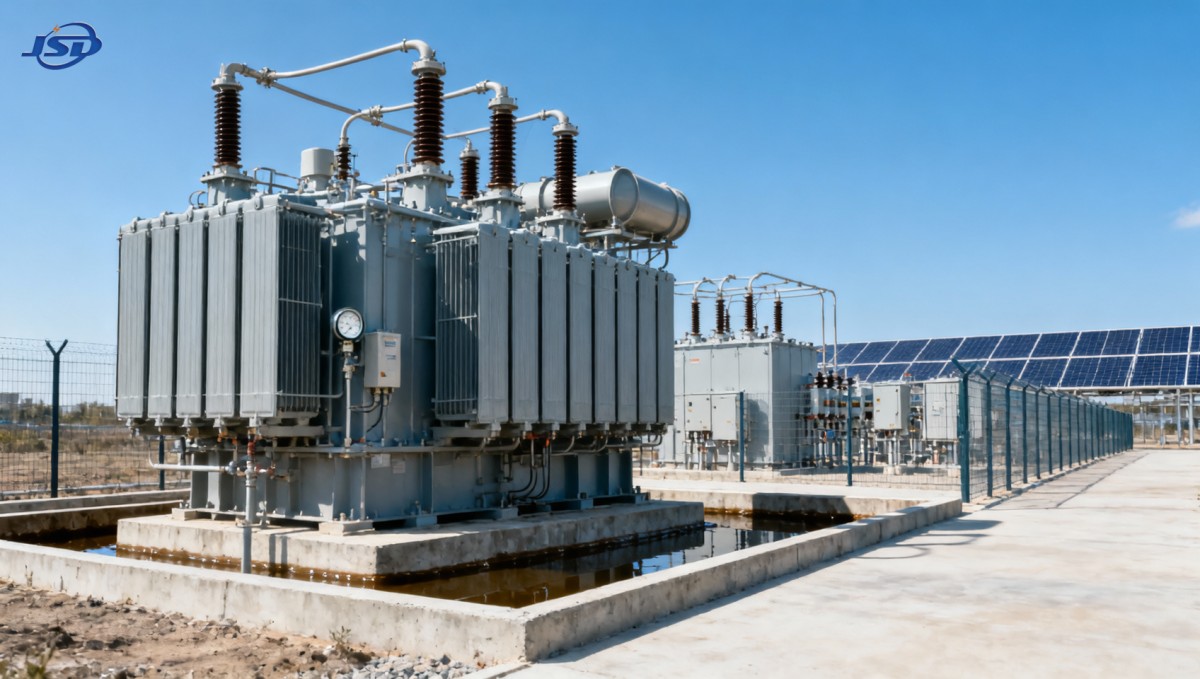
A quick fit check before choosing an outdoor oil-filled unit
Where an Oil-Filled Transformer May Not Be the Best Answer
The most common mistake is treating outdoor space as the only decision criterion. If a site is close to public areas, surrounded by buildings, or subject to stringent fire and environmental requirements, the civil and protection measures for an oil-filled installation may become substantial. Local regulations and insurer requirements should be reviewed early, particularly regarding separation distances, bunding, drainage, fire barriers, and emergency response provisions.
Indoor commercial developments can also favour dry-type transformers because the equipment can be located nearer to the load centre, sometimes reducing LV cable lengths and simplifying the architecture. In dense urban projects, the cost of land and the difficulty of creating a compliant external transformer area can outweigh the thermal and capacity benefits of oil immersion.
Another caution concerns highly corrosive or flood-prone locations. An outdoor oil immersed medium voltage transformer can be designed for challenging environments, but this requires more than selecting a higher enclosure rating on a datasheet. The elevation of the foundation, corrosion class assumptions, radiator protection, cable trench drainage, and long-term inspection plan all need to align. If the project team cannot control those conditions, a different installation concept may be safer.
Start With the Electrical Duty, Not the Transformer Rating Alone
A nameplate kVA value is necessary, but it is not a full selection basis. Project teams should establish the expected load curve, power factor, harmonic content, load growth path, and the likely effect of parallel sources before finalizing the transformer. Nonlinear loads from drives, rectifiers, charging systems, and industrial electronic equipment can change the thermal picture. Harmonics may require a design review of losses, temperature rise, neutral arrangements, and derating assumptions.
Voltage ratio and vector group must also match the protection and distribution philosophy. A mismatch here does not reveal itself as a minor procurement issue; it can affect parallel operation, fault response, metering arrangements, and downstream equipment compatibility. Tap range and tap-changer type should be based on anticipated supply variation and operating practice. It is worth asking whether voltage adjustment will be occasional and de-energized, or whether the network genuinely requires on-load regulation. The more complex option is not automatically the prudent one.
Short-circuit withstand capability needs similar discipline. The transformer has to suit the prospective fault level of the system, while the wider MV switchgear, cable network, and protection settings must be coordinated around the same design basis. A low initial fault level is not always permanent; future network reinforcement or added generation can alter the calculation.
Energy Storage Changes the Conversation at Renewable and Hybrid Sites
At solar-plus-storage and remote microgrid projects, transformer duty may become less predictable because battery inverters can charge, discharge, limit export, or support local loads at different times of day. The MV transformer remains a central interface between generation, storage, and the grid or facility network. Its rating should be assessed against simultaneous operating modes, not simply the peak rating of one asset.
On the low-voltage storage side, modular equipment can make phased deployment easier. For example, a 51.2V Stackable LiFePO4 Energy Storage Battery provides 5.12 kWh per 100 Ah module and can be expanded from 5.12 kWh to 20.48 kWh within its stated configuration. Its CAN and RS485 communication options may support integration with compatible inverter systems. This is not a substitute for MV transformer engineering; it is a reminder that storage expansion can change power flow assumptions over time.
A sensible design review asks what happens when PV export is high while batteries are charging, when storage discharges during a facility peak, and when the site changes between grid-connected and islanded operation, if islanding is part of the design. Protection philosophy, transformer impedance, grounding arrangement, and inverter controls should be reviewed as a system. Treating each package as an isolated procurement item is where interface problems begin.
Details That Protect Lifecycle Cost
Purchase price is visible; lifecycle risk tends to hide in the project exclusions. Before placing an order, clarify whether the scope includes bushings, temperature indicators, pressure relief devices, oil level indication, terminal boxes, marshalling connections, fans where applicable, surge arresters, and any monitoring interfaces needed by the site. The same applies to transport oil level, final oil filling, site assembly, testing responsibilities, and commissioning support.
Loss evaluation deserves attention as well. A transformer will consume energy whenever it is energized through no-load losses, and it incurs load losses as current increases. The right balance depends on operating hours, loading profile, local energy cost, and procurement criteria. A unit selected solely for the lowest upfront cost may not be the lowest-cost choice over its service period. Conversely, specifying the absolute lowest-loss design without considering actual utilisation can add capital cost with limited practical payback.
Maintenance access should be drawn, not merely discussed. Can personnel safely read gauges? Is there clearance to inspect bushings? Can a radiator valve or cable box be reached without removing surrounding equipment? Is there a realistic route for replacement or major repair? These questions sound basic, yet they are frequently discovered after fencing, ducts, and adjacent skids have been installed.
Working With the Manufacturer Before the Design Is Frozen
The best supplier discussions start with operating information, not just a request for a catalogue model. Share the MV and LV voltages, frequency, required capacity, site altitude, ambient range, system earthing method, fault level, load character, installation layout, and applicable local standards. If the project has unusual transport restrictions or seismic, coastal, desert, or cold-climate conditions, disclose them at the same stage.
Jinshida Electric Power Technology Co., Ltd. approaches transmission and distribution equipment with attention to manufacturing process, technical support, and quality management because these factors directly affect stable operation in grid, industrial, new-energy, and infrastructure applications. For project teams, the practical value of that approach is not a broad promise—it is the opportunity to resolve design interfaces before fabrication, when changes are still manageable.
Ask for clear drawings, guaranteed technical data, test documentation appropriate to the agreed specification, terminal arrangement details, weights, dimensions, and installation requirements. Review them against the civil, electrical, protection, and logistics packages. A transformer can be well made and still be wrong for the project if these interfaces are left unresolved.
A Decision Based on Site Reality
An oil immersed medium voltage transformer is usually the better outdoor fit when the project needs dependable cooling at meaningful capacity, has room for safe separation and maintenance access, and can properly manage environmental and fire-related requirements. It is particularly compelling for substations, industrial distribution yards, renewable energy plants, and infrastructure assets where robust serviceability is more valuable than placing the transformer inside a constrained building.
The final choice should be made after reviewing the electrical duty, climate, civil layout, regulatory obligations, maintenance model, and future operating modes together. If one of those elements remains uncertain, resolve it before procurement. That is usually far less expensive than adapting a transformer installation after the rest of the site has already been built.

Get a Quote
Regardless of whether you require general advice or specific support, we are happy to help you.
Send Us Your Inquiry Today

Jinshida Electric remains committed to contributing to global energy development through professional manufacturing and superior service.