





Oil-Immersed Electrical Substation Transformers: Insulation System Essentials
Insulation in an oil-immersed electrical substation transformer is a coordinated dielectric and thermal system, not simply a volume of oil surrounding energized parts. Its condition governs whether the transformer can withstand operating voltage, switching transients, local electric-field stress, and heat produced by winding losses over its intended service period. A sound assessment therefore examines the liquid insulation, cellulose-based solid insulation, dielectric clearances, oil circulation paths, sealing arrangement, and the moisture condition of the complete assembly.
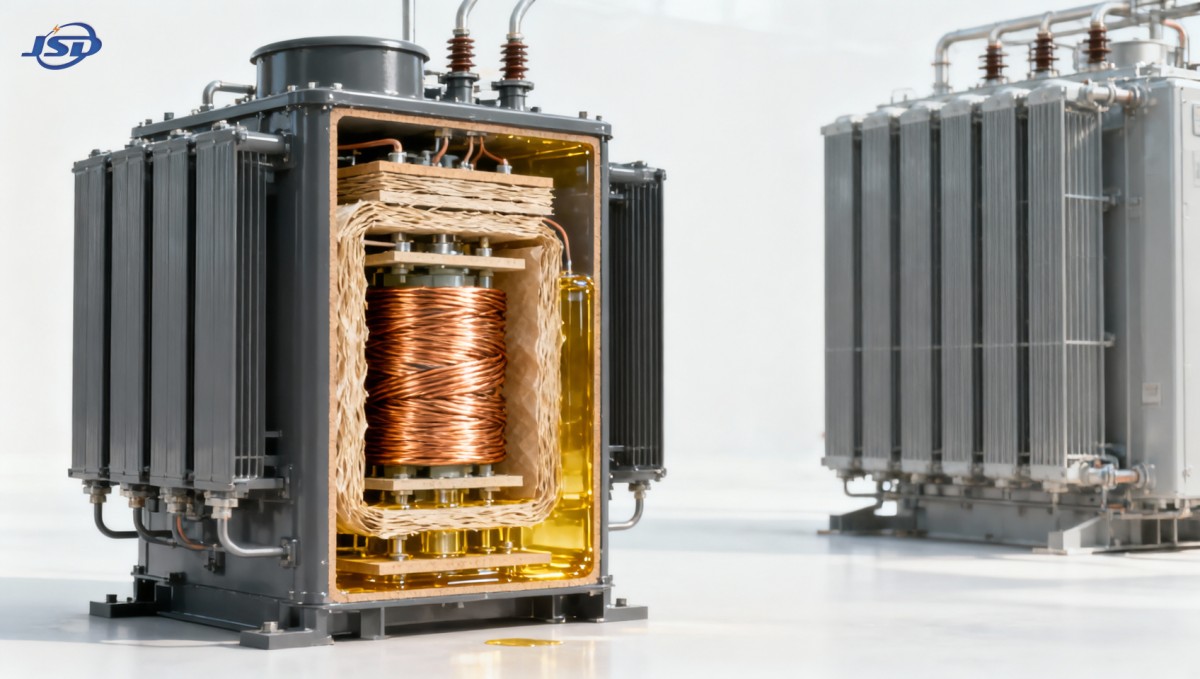
The most consequential point is that oil and paper do not age independently. Insulating liquid transfers heat away from windings and provides dielectric strength in spaces between conductors, while paper, pressboard, and other solid components establish conductor spacing and support the windings mechanically. Heat, oxygen, moisture, and electrical stress affect both materials, but moisture has a particularly uneven effect: a modest amount dissolved in oil may correspond to a much greater water content in cellulose. Oil test results alone therefore cannot establish the condition of the solid insulation.
What the insulation system must withstand
Normal power-frequency voltage is only one part of the duty. Winding insulation must also tolerate induced voltages between turns, sections, and layers; line-end stresses; switching surges; and impulse stresses associated with the connected network. The most highly stressed locations are often not visually obvious from the external voltage rating. Lead exits, tap connections, winding ends, sharp metallic edges, and narrow oil gaps can concentrate the electric field if the geometry, drying process, or assembly accuracy is poor.
Thermal and mechanical duties interact with dielectric performance. Copper losses heat the conductor, and the insulation immediately adjacent to it operates at a higher temperature than bulk oil. Load cycling expands and contracts windings and leads. Through-fault forces can shift conductors or compress spacers. A transformer may retain acceptable oil breakdown voltage while damaged blocking, displaced paper, or loosened clamping has created a future partial-discharge or short-circuit risk. Insulation review should consequently connect electrical tests with the transformer design, load profile, and evidence of mechanical integrity.
Liquid insulation: function, limits, and fluid selection
Mineral insulating oil remains widely used because it combines cooling capability, dielectric performance, and established handling practices. Its performance depends on cleanliness, dryness, oxidation stability, and preservation from air ingress. Particles, fibres, free water, and gas bubbles lower dielectric margin, especially in high-field regions. A low bulk moisture result does not remove concern when the unit has been exposed to repeated thermal cycling or a compromised seal, because water may redistribute between the oil and cellulose as temperature changes.
Natural ester fluids, including FR3 vegetable oil, have different moisture distribution behavior, viscosity, oxidation characteristics, and fire-related properties from mineral oil. They should not be treated as a direct drop-in choice without reviewing the complete design. Higher fluid viscosity affects cooling flow and can alter winding hot-spot temperature under a given loading condition. The acceptable materials set, drying method, fluid test interpretation, conservator or sealed-tank arrangement, and maintenance procedures must all be aligned with the selected liquid. A fluid change without that system-level review can produce misleading test comparisons or inadequate thermal performance.
Oil quality indicators should be read together rather than in isolation. Breakdown voltage is sensitive to contamination and water, but it does not directly measure paper strength. Acidity and interfacial behavior can indicate oxidation and polar contamination, while dielectric dissipation factor can reveal deterioration that breakdown voltage alone misses. Dissolved-gas analysis is useful for identifying active electrical or thermal fault signatures, but it is not a substitute for determining residual moisture, paper condition, or internal geometry. A single abnormal result deserves confirmation against sampling method, operating temperature, previous trends, and any recent oil treatment before it is assigned to an internal fault.
Solid insulation sets the long-term limit
Cellulose insulation includes conductor paper, pressboard barriers, spacers, ducts, cylinders, and structural pieces. It performs several jobs at once: it separates conductors, shapes oil channels, restrains winding movement, and withstands local voltage gradients. Its aging is largely irreversible. As cellulose chains degrade, tensile strength and resistance to mechanical disturbance decline. This matters most after years of thermal exposure, because a winding that remains electrically serviceable under steady load can become vulnerable when a fault imposes high mechanical forces.
Drying quality before oil filling is therefore a design and manufacturing issue rather than a routine final inspection item. Thick pressboard sections release moisture slowly. If the active part is not dried thoroughly, oil processing after assembly can improve the liquid test values while leaving excessive moisture in the solid insulation. Vacuum treatment, controlled heating, clean handling, and timely filling are interdependent. The interval between drying and oil filling should be managed because hygroscopic cellulose can reabsorb moisture from ambient air.
Paper type and thermal class must match the intended winding temperature. Upgraded cellulose materials can permit different thermal operating margins, but the benefit is meaningful only when conductor temperature, oil circulation, lead insulation, tap-changer interface, and cooling equipment are evaluated together. Calling a transformer “high-temperature capable” without identifying the limiting insulation component leaves an incomplete technical basis.
Moisture control is a condition-management discipline
Water affects dielectric strength, accelerates cellulose aging, and can form bubbles under elevated temperature if local saturation conditions are reached. The significance of a measured moisture value changes with temperature, liquid type, paper mass, and equilibrium conditions. Cold oil holds less dissolved water than hot oil, so samples from different operating temperatures cannot be compared casually. A sample taken soon after load reduction may not represent moisture equilibrium between oil and paper.
Moisture can enter through failed gaskets, poorly maintained breathers, damaged radiators, open inspection covers, or inadequate storage practice before energization. It can also originate from residual moisture after manufacturing or repair. These sources require different corrective actions. Improving a breather does not remove water already held in the cellulose; oil dehydration can reduce water in the liquid but may require time and temperature management for moisture to migrate outward from paper. Treating every moisture issue as an oil-filtration issue can leave the underlying problem unresolved.
A sealed transformer reduces contact with atmospheric moisture, but it depends on gasket quality, welded-joint integrity, pressure behavior, and correct assembly of accessories. A conservator arrangement requires reliable separation or breathing control appropriate to its design. In either configuration, routine external inspection has value: oil stains, distorted seals, corroded fittings, blocked pressure-relief paths, and unexplained oil level changes are early indicators that the insulation environment may no longer be controlled.
Cooling design changes insulation life expectations
Cooling is part of insulation engineering because the hot-spot temperature is a primary driver of cellulose aging. Tank surface area, radiators, cooling ducts, oil path geometry, winding arrangement, and the operating state of fans or pumps determine how effectively heat reaches the ambient environment. A rating plate capacity cannot be interpreted separately from ambient temperature, altitude, solar exposure, enclosure ventilation, harmonic loading, and load duration.
Short-duration overload capability must be evaluated against thermal history, not only instantaneous current. A copper-wound transformer may permit a defined short overload under stated conditions, yet the relevant insulation question is whether oil temperature, winding hot spot, and cooling availability remain within the design limits throughout the event. Repeated overloads that appear individually acceptable can progressively age the paper and increase moisture mobility. Temperature alarms, top-oil indication, and trend records provide more useful evidence than a load-current snapshot alone.
Harmonic-rich loads deserve separate treatment. Harmonics increase eddy-current and stray losses, which may heat localized conductor and structural regions more than fundamental current calculations suggest. The resulting hot spots can occur where oil flow is restricted, making a transformer with satisfactory average oil temperature still vulnerable to localized insulation stress. Data centers, power-electronic industrial loads, and renewable-energy connections should therefore be reviewed for harmonic spectrum and loading pattern as part of insulation duty.
Dielectric geometry and workmanship
Clearances in oil and creepage paths along solid insulation are defined by more than nominal voltage. Manufacturing tolerances, lead positioning, burr control, surface cleanliness, and compression of pressboard components influence local field distribution. An oil duct intended for cooling can also be a dielectric gap; a misplaced spacer can alter both functions. During repair or factory inspection, attention should focus on winding-end leads, bushing connections, tap leads, barriers around high-voltage sections, and areas where flexible cable insulation passes near sharp or grounded metal.
Partial discharge is especially relevant where voids, gas pockets, contamination, or field enhancement exist. Its absence in a limited test condition does not prove that all service conditions are benign, because discharge inception can change with temperature, pressure, moisture state, and applied waveform. Conversely, an unusual electrical signal requires disciplined interpretation; external interference, test leads, and accessory components can create false indications. Correlation with test setup, repeatability, dissolved gases, and internal design locations is necessary before invasive work is justified.
Specification evidence that supports a defensible review
For a new oil immersed electrical substation transformer, the insulation section of the technical documentation should state the liquid type, solid insulation system, thermal assumptions, dielectric test duties, and cooling arrangement in enough detail to reveal whether the design matches the installation. Generic statements such as “high-quality oil” or “excellent insulation” do not identify the actual dielectric system.
Documented routine dielectric tests confirm that a completed unit met specified test conditions at the time of manufacture. They should be read with the design information rather than used as the sole indicator of future insulation life. A transformer installed in a hot, poorly ventilated enclosure with frequent cyclic overload has a different thermal trajectory from an identical unit serving a stable outdoor load.
For a 20 kV distribution application converting to 0.4 or 0.415 kV, the insulation review should also include neutral grounding method, cable termination arrangement, low-voltage fault level, and the environmental control around the tank. The 20kV/0.4kV Oil-Immersed Power Distribution Transformer configuration illustrates why voltage conversion data alone is insufficient: liquid selection, copper winding temperature, short-term overload conditions, and the installation environment must be considered as one insulation duty.
Inspection findings that should not be conflated
Darkened oil, elevated gas levels, rising moisture, abnormal temperature, and reduced dielectric test values can all be associated with insulation deterioration, yet they do not point to the same failure mechanism. Darker liquid may reflect oxidation or material interaction without proving active overheating. Elevated combustible gases may arise from a developing internal thermal fault, a past event, or sampling and handling issues. High temperature can result from restricted cooling, excessive load, harmonic losses, poor connections, or an internal winding problem. The value of condition monitoring comes from trends and cross-checks, not from attaching a single diagnosis to one symptom.
Transport and installation can also disturb a previously satisfactory insulation system. Excessive shock, prolonged storage, damaged bushing packaging, open connections, or rain exposure before final sealing can introduce risk that routine factory tests did not cover. Before energization, the tank exterior, bushing interfaces, oil level indication, grounding connections, cooling accessories, and seal condition should be verified against the shipping and installation records. Where storage duration or exposure was significant, the decision to perform additional oil or electrical tests should reflect the actual preservation condition rather than a fixed calendar interval.
A durable insulation system is achieved by maintaining the relationship between dry solid insulation, clean compatible liquid, controlled electric fields, and adequate heat removal. Weakness in one part often shifts stress into another. That relationship is the basis for selecting, testing, installing, and monitoring an oil-immersed transformer with credible long-term dielectric margin.

Get a Quote
Regardless of whether you require general advice or specific support, we are happy to help you.
Send Us Your Inquiry Today

Jinshida Electric remains committed to contributing to global energy development through professional manufacturing and superior service.