





33 kV Dry-Type vs. Oil-Filled Transformers for Indoor Substations
A 33 kV dry-type transformer is a strong candidate for an indoor substation when eliminating insulating liquid materially reduces fire-containment requirements and the room can support adequate cooling, electrical clearances, and environmental control. An oil-filled transformer remains a credible alternative where liquid cooling, thermal performance, or equipment dimensions provide a better engineering fit—and where the building can accommodate the associated fire and spill precautions.
The decision should therefore compare complete installed systems, not transformer purchase prices alone. Neither “dry-type means fireproof” nor “oil-filled means unsuitable indoors” is a sound selection rule. The practical choice depends on the consequences of a fault, the actual room conditions, the load profile, and the evidence available for the proposed design.
Define the electrical duty before comparing construction types
“33 kV” identifies a nominal system voltage, not a complete transformer specification. Establish the transformation ratio, rated apparent power in kVA or MVA, frequency, vector group, neutral arrangement, impedance, tapping requirements, and highest voltage for equipment. A 33 kV network commonly uses equipment in the 36 kV class under IEC practice, but the applicable utility specification and insulation-coordination study must determine the required ratings.
Dry-type and oil-filled bids are comparable only when these duties match. Different impedance values affect fault current and voltage regulation; different cooling ratings change the usable capacity. A dry-type quotation with a fan-assisted rating should not be compared directly with an oil-filled quotation rated for continuous natural cooling without accounting for fan availability and auxiliary power.
The IEC 60076 series provides the relevant transformer framework, including IEC 60076-11 for dry-type transformers, IEC 60076-2 for temperature rise in liquid-immersed transformers, and IEC 60076-3 for insulation levels and dielectric tests. The contract should identify the applicable editions and local requirements. Compliance with a transformer standard does not, by itself, approve the indoor installation.
Fire safety is a room-level decision
Dry-type construction eliminates the insulating-liquid inventory and its associated leakage and pool-fire hazards. This can be a decisive advantage inside occupied buildings, below grade, or where installing a containment system would be difficult. It does not eliminate electrical arcing, insulation decomposition, smoke, or fire propagation through nearby cables and equipment.
Cast-resin and other dry-type designs also should not be treated as interchangeable. Where IEC 60076-11 environmental, climatic, or fire-behaviour classes are specified, require evidence applicable to the offered design. A claimed fire-behaviour class is a defined performance characteristic—not a statement that the complete substation is non-combustible.
For an oil-filled installation, identify the liquid before assessing risk. Mineral oil and less-flammable ester liquids have different fire properties, and a qualifying less-flammable liquid may permit different installation arrangements under the applicable rules. However, changing the fluid does not automatically remove requirements for compartmentation, containment, ventilation, or separation. Fluid compatibility, dielectric performance, and transformer design must also be confirmed.
The approval question is whether the complete installation meets local building and electrical rules, utility requirements, insurer conditions, and the authority having jurisdiction. Depending on the site, the design may need fire-rated construction, suitable doors, spill retention, drainage isolation, detection, or suppression. These provisions belong in the initial comparison, not in a late-stage construction variation.
Ventilation can determine whether the selected rating is usable
Both transformer types reject heat into an indoor room unless a separate arrangement carries that heat elsewhere. Liquid cooling transfers heat from the windings to the tank and radiators; it does not make the room heat load disappear. Likewise, a dry-type enclosure cannot compensate for inadequate building ventilation.
Calculate room heat rejection from guaranteed no-load and load losses at the intended operating conditions, together with relevant auxiliary and nearby equipment loads. No-load loss remains present while the transformer is energized. Load loss varies approximately with the square of current, with additional effects from temperature and harmonic content.
A preliminary airflow estimate can use Q = P / (ρ × cp × ΔT), where P is heat rejection, Q is airflow, and ΔT is the permitted temperature rise of the ventilation air. Final sizing must also consider louvres, filters, duct resistance, fan duty, air recirculation, and the actual airflow path through the equipment.
The critical ambient is the air entering the transformer, not the outdoor weather-station temperature. A room can overheat even when the building’s general HVAC system appears adequate. Specify the permissible inlet temperature and the operating response to ventilation failure, including alarms, load reduction, or shutdown where necessary.
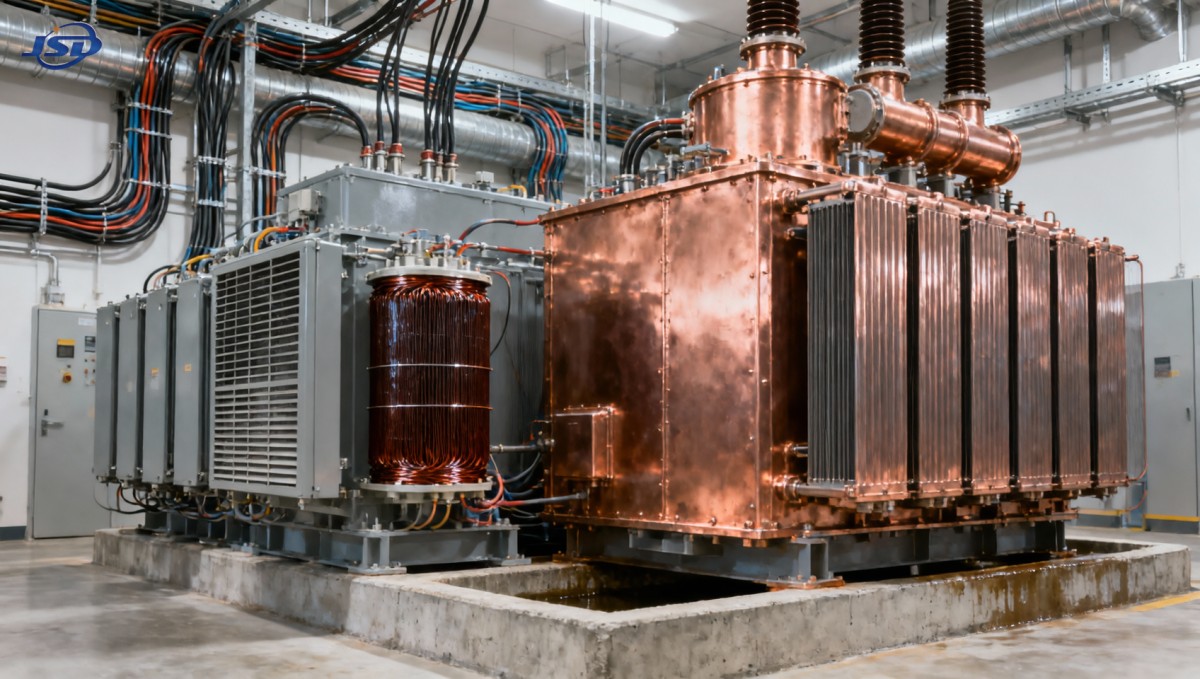
Request temperature-rise evidence for the offered enclosure and cooling configuration. An enclosure can protect against access or contamination while restricting airflow. If a dry-type design depends on forced cooling for the required capacity, establish its continuous rating with fans unavailable. Apply the same scrutiny to oil-filled designs that depend on fans or pumps.
At 33 kV, insulation coordination and contamination deserve close attention
The absence of oil does not simplify every insulation issue. Dry-type windings, terminals, and connections depend on coordinated solid insulation and air clearances. Dust, moisture, conductive contamination, and condensation can create surface-tracking or discharge risks even when the resin itself remains intact.
A clean indoor location and an enclosed room exposed to salt, process dust, or humid shutdown periods are different service environments. Specify contamination exposure, humidity, condensation risk, cleaning access, and any anti-condensation measures. An enclosure ingress-protection rating alone does not describe the internal moisture conditions or demonstrate insulation suitability.
For oil-filled units, the liquid protects internal insulation from direct exposure to room air, but moisture control remains important. Sealing arrangements, conservators, breathers where fitted, gaskets, and oil condition influence long-term insulation performance. External bushings and cable terminations still require appropriate clearances and environmental protection.
For either construction, select power-frequency and lightning-impulse withstand levels through insulation coordination. Consider incoming cable characteristics, overhead-line interfaces, surge-arrester placement, and switching events. Where vacuum switching or a particular cable arrangement raises concern about fast-front transients, evaluate the need for additional mitigation rather than assuming standard dielectric tests cover every network condition.
For a proposed 33kv dry type transformer, request applicable dielectric and partial-discharge test documentation. Confirm that the evidence covers the relevant voltage class and design features. A generic certificate or a report for a materially different winding arrangement is not equivalent to evidence supporting the offered unit.
Load profile matters more than a simple capacity margin
Insulation thermal class alone does not establish overload capability. A higher-temperature insulation system is not a licence to increase continuous loading without checking winding hot spots, temperature-rise limits, enclosure conditions, and expected insulation ageing.
Oil-filled designs can offer useful thermal inertia during changing loads, but permissible overload still depends on prior loading, ambient temperature, cooling condition, and design limits. Dry-type overload capability is also design-specific. Use the applicable loading guidance and manufacturer calculations rather than a generic overload percentage.
Specify the expected daily load curve, emergency duration, motor-starting duties, and converter-related harmonics. Harmonics can increase winding eddy-current and stray losses, so a transformer sized only from fundamental-frequency kVA may be inadequate. Provide the anticipated current spectrum or an agreed assessment basis.
If the substation also connects equipment such as a 500kW/1MWh Air Cooling Container Energy Storage System, its stated 400 V AC interface requires appropriate transformation and protection to connect to a 33 kV system. Bidirectional power flow, PCS harmonics, reactive-power duty, and operating schedules belong in the transformer specification. The storage system’s power rating alone does not determine transformer kVA or favour either insulation type.
Compare installed envelopes, not catalogue dimensions
Oil-filled construction may provide a compact active assembly, but tank, radiator, containment, and maintenance requirements can change the installed footprint. Dry-type equipment may avoid a bund while requiring substantial enclosure space, ventilation openings, and clearances around terminals. There is no reliable universal footprint advantage without comparing actual layouts.
Request general arrangement drawings that show cable boxes, termination access, doors, lifting points, centre of gravity, and maintenance envelopes. Verify the delivery route, floor loading, doorway dimensions, and replacement route. A unit that fits inside the room may still be impossible to remove without structural work.
Acoustic performance also requires a defined basis. Core noise, load-related noise, fan noise, enclosure behaviour, and structure-borne vibration all matter near occupied spaces. Compare guarantees measured under consistent conditions and distinguish sound power from sound pressure at a stated distance. Room acoustics can substantially alter the sound level experienced outside the substation.
Maintenance burden and recovery time are different questions
Dry-type transformers avoid oil sampling and liquid-handling work, but they are not maintenance-free. Inspection may include contamination, connections, temperature sensors, fans, ventilation passages, and evidence of tracking or discharge. Cleaning methods must be compatible with the insulation system, and safe access must be designed into the room.
Oil-filled maintenance depends on construction and criticality. It may include leak inspections, cooling-system checks, oil-quality assessment, and dissolved-gas analysis where appropriate. Sealed designs reduce some routine tasks but do not eliminate the need to assess insulation condition and protective devices.
Reliability planning should also address recovery after failure. Replacing a dry-type coil may require manufacturer-specific parts and specialist work. Repairing an oil-filled unit can require liquid handling, drying, processing, and testing. Neither construction guarantees rapid restoration. For a critical supply, spare strategy, replacement access, redundancy, and supplier support may outweigh differences in routine servicing cost.
Make the award decision on equivalent guarantees
Lifecycle evaluation should include transformer price, civil works, fire protection, ventilation energy, guaranteed losses, maintenance, and the operational consequences of outages. Apply the actual load profile when capitalizing losses; low purchase cost or low full-load loss alone does not establish the lowest operating cost.
Before accepting either design, obtain:
- Guaranteed ratings, losses, impedance, temperature rise, and insulation levels on a common specification basis.
- Applicable routine-test results and type- or special-test evidence, with design differences clearly identified.
- Confirmed room-layout, ventilation, environmental, and protection requirements.
- A documented cooling-failure response and emergency-loading basis.
- Maintenance access requirements, repair provisions, and replacement arrangements.
Choose dry-type construction when removing insulating liquid resolves a meaningful indoor risk and the environment, ventilation, and dielectric design are demonstrably suitable. Choose oil-filled construction when its verified thermal or dimensional advantages justify the necessary building safeguards. If either option depends on unverified room cooling, inadequate clearance, or undocumented insulation performance, it is not yet a defensible selection.

Get a Quote
Regardless of whether you require general advice or specific support, we are happy to help you.
Send Us Your Inquiry Today

Jinshida Electric remains committed to contributing to global energy development through professional manufacturing and superior service.