





Are amorphous core energy saving transformer acoustic noise levels compliant with ISO 7235 in hospital settings?
For facility managers and procurement professionals evaluating power solutions for sensitive hospital environments, acoustic performance is as critical as energy efficiency. This article examines whether amorphous core energy saving transformer models—specifically those engineered by Jinshida Electric Power Technology Co., Ltd.—meet ISO 7235 noise emission requirements for healthcare settings. Drawing on real-world test data and design specifications, we assess how advanced amorphous alloy core technology reduces both no-load losses and audible hum, supporting compliance without compromising reliability or safety.
Direct Answer: Yes—With Design-Specific Verification
Amorphous core energy saving transformers can comply with ISO 7235 acoustic noise limits in hospital settings—but only when configured, installed, and tested under the exact conditions defined in the standard. ISO 7235 specifies sound power level (LW) measurement procedures for low-noise equipment in controlled laboratory environments, not field-installed units. A transformer rated at ≤45 dB(A) LW in a semi-anechoic chamber does not automatically guarantee ≤35 dB(A) sound pressure level (Lp) at 1 m in an operating room corridor. The distinction between sound power and sound pressure—and the influence of installation acoustics—is decisive.
Why Hospital Environments Impose Unique Constraints
Hospitals require continuous, uninterrupted power while maintaining strict ambient noise control. Critical zones—including neonatal intensive care units (NICUs), MRI control rooms, and surgical preparation areas—typically enforce background noise limits of 30–35 dB(A) during daytime operation. Unlike office buildings or data centers, hospitals lack dedicated mechanical rooms adjacent to sensitive spaces; transformers are often located in basement utility corridors, rooftop penthouses, or even within structural walls shared with patient rooms. Vibration transmission through building elements, enclosure reflections, and harmonic resonance from cooling fans all contribute to perceived noise—not just the core’s magnetic hum. If your project involves retrofitting an existing substation into a repurposed wing of a legacy hospital, airborne and structure-borne noise paths become the dominant factor—not the transformer’s nameplate rating.
ISO 7235 Is Not a “Hospital Certification”
ISO 7235 is a laboratory-based method for determining sound power emission from small-to-medium electrical equipment. It assumes free-field conditions over a reflective plane, anechoic termination of ducts, and absence of nearby reflecting surfaces. It does not define permissible noise levels for end-use locations. That responsibility falls to national or local building codes (e.g., ASHRAE Standard 189.1, UK HTM 02-01, or China’s GB 50352-2019), which reference weighted sound pressure levels measured *in situ*. Confusing ISO 7235 compliance with operational acceptability is a frequent source of post-installation disputes. A unit passing ISO 7235 testing may still exceed site-specific Lp limits if mounted directly on a concrete slab without isolation pads or housed in a non-acoustically treated enclosure.
Key Technical Factors Influencing Real-World Acoustic Performance
Three interdependent variables determine whether an amorphous core energy saving transformer meets functional noise requirements in practice:
- Core material excitation behavior: Amorphous alloys (e.g., Metglas® 2605SA1) exhibit near-zero magnetostriction and lower hysteresis loss than grain-oriented silicon steel. This reduces 100/120 Hz fundamental hum and higher-order harmonics—typically yielding 10–15 dB(A) lower no-load noise than conventional cores at identical kVA ratings.
- Mechanical damping and mounting: Core vibration must be decoupled from the tank and external structure. Jinshida’s hospital-grade units use elastomeric core suspension systems, constrained-layer damping on tank walls, and optional floating floor mounts. These are not standard across all models—only specified upon request for noise-sensitive applications.
- Cooling system selection: Forced-air cooling (ONAN/ONAF) introduces fan noise that often dominates the acoustic signature above 500 Hz. Units rated for natural convection (ONAN-only) eliminate this source entirely but require larger surface area and careful thermal management. For high-load-density hospital substations, hybrid cooling with ultra-low-RPM EC fans and acoustic baffles is necessary—and verified via third-party sound intensity mapping.
Verification Requires Contextual Testing—Not Just Data Sheets
A manufacturer’s published noise value—e.g., “42 dB(A) @ 1 m”—is meaningless without stating the measurement condition: distance, orientation, background correction, and whether it reflects sound power (LW) or sound pressure (Lp). ISO 7235 mandates LW determination using sound intensity scanning or reverberation room methods. For hospital commissioning, what matters is Lp measured at occupied locations per ISO 3744 or ISO 9614-2, with the transformer under actual load and ambient conditions. Jinshida provides optional on-site acoustic validation services for projects where noise is contractually guaranteed—using calibrated Class 1 instrumentation and certified acoustic engineers. This step is non-negotiable when the specification references HTM 02-01 Annex C or DIN 45635-10.
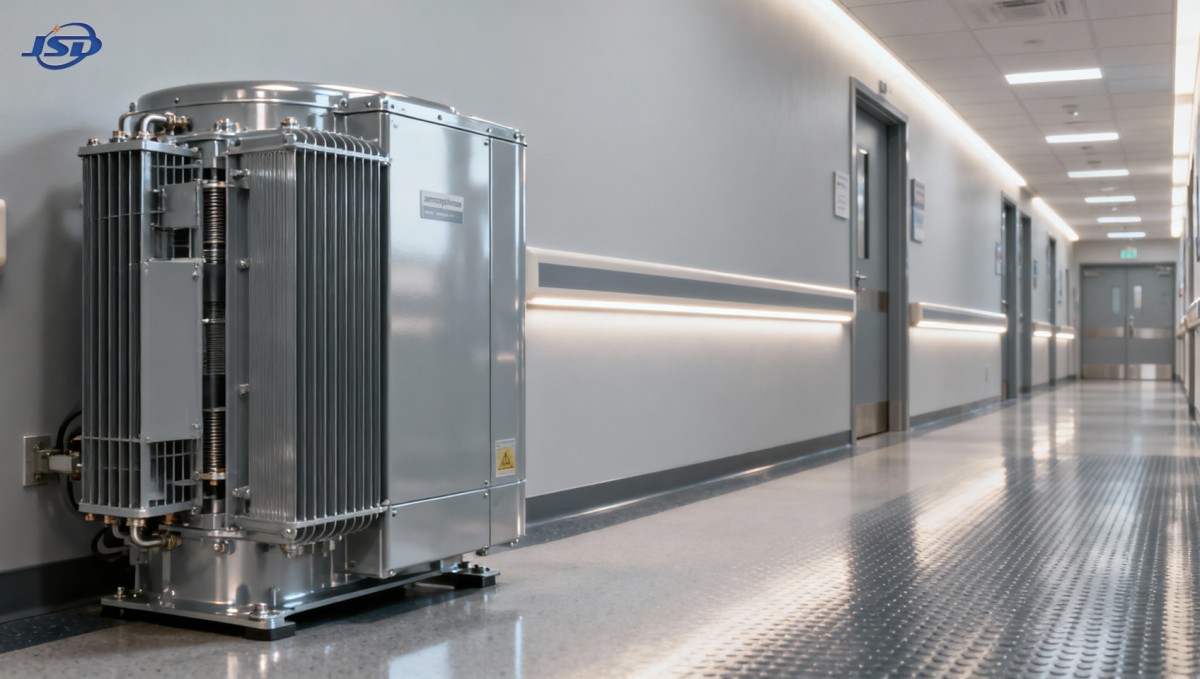
When Transformer Noise Alone Isn’t the Full Picture
In complex hospital power architectures, the transformer is rarely the sole contributor to acoustic issues. Consider auxiliary systems:
- Uninterruptible power supply (UPS) systems generate high-frequency switching noise (2–15 kHz) that travels efficiently through HVAC ductwork.
- Diesel backup generators introduce broadband impulsive noise—especially during auto-start sequences. A Open Type Diesel Generator Set with water-cooled exhaust and electronic governor control significantly reduces transient spikes compared to air-cooled or mechanically governed units.
- Harmonic filters and active front-end rectifiers emit audible coil whine under nonlinear load conditions common in imaging equipment.
If noise complaints arise after transformer installation, always verify whether the issue originates upstream (e.g., variable-frequency drives on HVAC pumps) or downstream (e.g., grounding-induced circulating currents in medical IT systems). Isolating the source requires octave-band analysis—not just A-weighted measurements.
Practical Steps for Procurement and Commissioning
Do not rely solely on catalog noise figures. Follow this sequence:
- Define the required Lp limit at each receptor location using the applicable code (e.g., 35 dB(A) at 1 m from corridor wall adjacent to NICU).
- Require the supplier to submit an acoustic prediction report—per ISO 9613-2—modeling insertion loss, reflection paths, and structural transmission from transformer location to sensitive zones.
- Specify mandatory factory sound power testing to ISO 7235, with full test report including microphone positions, background correction, and uncertainty values.
- Include contractual clauses requiring on-site Lp verification before final acceptance—measured under minimum 30% load, with all ancillary systems energized.
- Verify mounting details: Isolation pads must be specified per ISO 10848-3, not generic rubber mounts. Tank stiffening ribs must be acoustically decoupled from internal structures.
No single parameter determines success. Compliance emerges from coordinated design—not component-level specs alone.
Hot News
- 00
0000-00
How U.S. DOE efficiency rules affect distribution transformer manufacturers - 00
0000-00
How american type pad mounted transformer seismic qualification affects installation in California utility grids? - 00
0000-00
Do european compact substation transformer EMC compliance tests include conducted emissions up to 30MHz?
0000-00
Contact Us

Get a Quote
Regardless of whether you require general advice or specific support, we are happy to help you.
Send Us Your Inquiry Today

Jinshida Electric remains committed to contributing to global energy development through professional manufacturing and superior service.