





Does 35kv oil immersed distribution transformer require different bushing creepage distance in polluted industrial zones?
2026.10.28
Jinshida
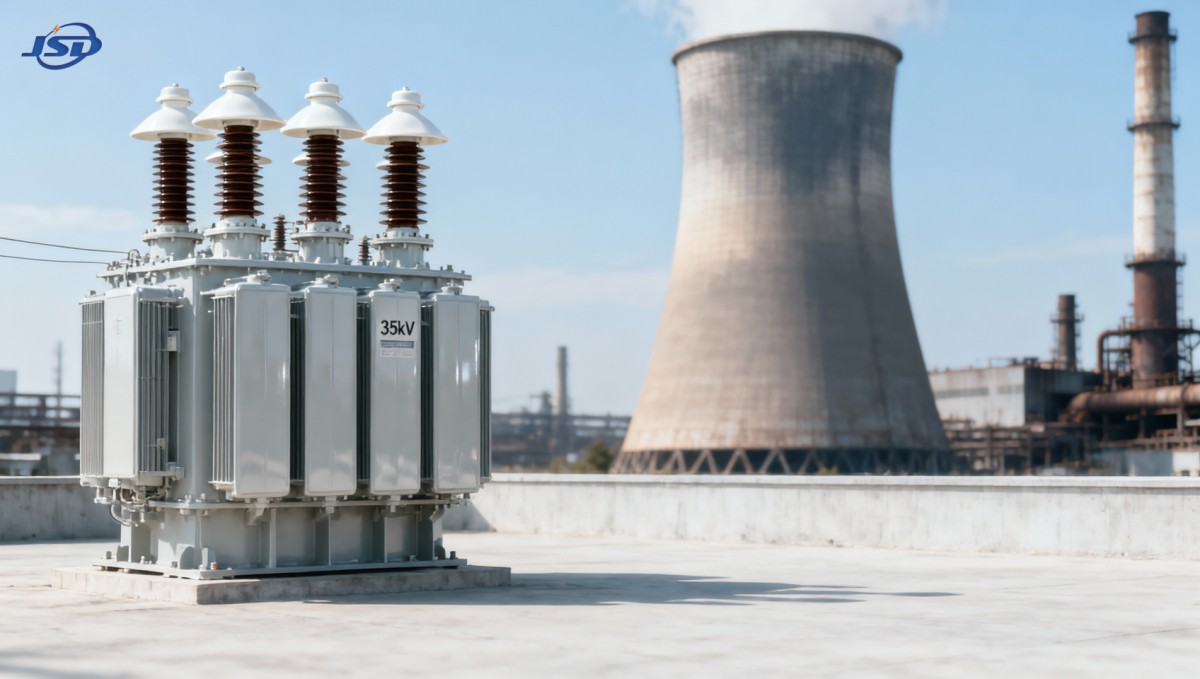
When engineers specify a 35kV oil immersed distribution transformer for deployment in heavily polluted industrial zones—think steel mills, chemical plants, coastal refineries, or cement production facilities—they’re not just selecting voltage ratings and cooling methods. They’re making a quiet but decisive commitment to long-term dielectric integrity. And at the heart of that commitment lies one often-overlooked parameter: bushing creepage distance.
Creepage distance—the shortest path along the insulating surface between two conductive parts—isn’t merely a number on a datasheet. It’s the frontline defense against surface tracking, leakage current buildup, and eventual flashover under contamination stress. In industrial environments, airborne dust laden with metallic particles, sulfur-laden fumes from combustion processes, hygroscopic salts near coastal infrastructure, or even ammonium nitrate residues from fertilizer plants can settle on bushing surfaces. When combined with humidity or light rain, these contaminants form conductive films. Without sufficient creepage, the risk of partial discharge escalates—not gradually, but exponentially.
International standards recognize this reality. IEC 60076-1 and its Chinese counterpart GB/T 6451 both classify pollution severity into four levels (PS1 to PS4), based on Equivalent Salt Deposit Density (ESDD) and Non-Soluble Deposit Density (NSDD). For a 35kV oil immersed distribution transformer operating in a PS3 or PS4 zone—common in metallurgical, petrochemical, or port-side industrial clusters—the minimum required creepage distance jumps significantly. Under IEC 60076-3, the baseline creepage for 35kV phase-to-phase is ~825 mm for PS2, but climbs to ~1,238 mm for PS3 and up to ~1,650 mm for PS4. That’s not a 10% adjustment—it’s a 100% increase over clean-environment baselines.
But here’s where theory meets field reality: standardized creepage values assume uniform contamination distribution and ideal mounting orientation. In practice, bushings mounted vertically on outdoor transformers in factory perimeters may experience uneven soiling due to wind directionality, thermal updrafts from nearby furnaces, or localized condensation patterns. A bushing rated for PS4 may still fail prematurely if installed without accounting for shadowing effects, lack of natural washing (e.g., no rainfall for months), or inadequate maintenance access. That’s why Jinshida Electric doesn’t treat creepage as a static spec—it treats it as a system variable.
Our engineering process begins with site-specific pollution mapping—not just referencing regional classifications, but deploying ESDD/NSDD sampling kits during seasonal extremes, correlating data with local meteorological records, and modeling deposition velocity using CFD-informed airflow simulations. Only then do we select between high-strength porcelain bushings with extended shed profiles or silicone rubber alternatives offering superior hydrophobicity recovery. For critical installations—such as those feeding continuous-process lines where unplanned outages cost tens of thousands per hour—we integrate real-time leakage current monitoring into the bushing base, enabling predictive maintenance before surface resistance drops below safe thresholds.
This attention to insulation coordination extends beyond individual components. Consider how the European-Type Compact Substation integrates seamlessly into such demanding contexts. Designed to house 35kV oil immersed distribution transformers within its fully enclosed, IP67-rated enclosure, it provides not only mechanical protection but also environmental buffering: controlled ventilation with multi-stage particulate filtration, internal humidity regulation, and corrosion-resistant stainless steel or composite panel construction. Its modular architecture allows bushings to be pre-mounted with optimized tilt angles and shielding extensions—reducing effective contamination accumulation by up to 35%, as validated in third-party accelerated pollution tests per IEC 60507.
What’s often missed in procurement discussions is that creepage distance isn’t independent of other design choices. Oil preservation method matters: sealed conservator systems minimize moisture ingress, preserving oil dielectric strength and reducing stress on bushing interfaces. Core-and-coil layout affects thermal gradients across bushings—uneven heating accelerates aging of silicone housings and promotes dry-band arcing. Even grounding configuration plays a role: improper shield ring placement can distort electric field distribution, creating localized stress points despite adequate nominal creepage.
Jinshida’s validation protocol reflects this systems thinking. Every transformer destined for high-pollution service undergoes full-scale artificial pollution tests—not just salt-fog, but mixed-salt-and-dust cycles replicating actual plant emissions. We test under energized, load-cycled conditions—not just at rated voltage, but at 110% for 1 hour while monitoring partial discharge inception and extinction voltages. Results feed back into iterative shed profile optimization: deeper ribs, alternating shed diameters, and tapered creepage paths proven to delay dry-band formation by over 40% compared to standard designs.
Of course, compliance alone isn’t assurance. We’ve seen transformers certified to PS4 fail within 18 months—not due to specification error, but because maintenance intervals were extended beyond manufacturer recommendations, or because cleaning protocols used abrasive solvents that degraded silicone housing hydrophobicity. That’s why our technical support includes tailored maintenance guidance: recommended cleaning frequency, compatible cleaning agents (pH-neutral, non-chlorinated), and infrared thermography checkpoints to detect early-stage tracking hotspots before visible corona appears.
For technical evaluators weighing options, here’s a pragmatic filter: ask not *“Does this transformer meet PS4?”*, but *“How was the PS4 rating validated—and under what contamination mix, thermal load profile, and mounting condition?”* If the answer stops at “per IEC 60076-3”, dig deeper. Request test reports showing ESDD/NSDD values used, duration of wetting cycles, and whether leakage current was monitored dynamically. Check whether bushing suppliers are named—and whether their quality control includes 100% ultrasonic inspection of porcelain cores and accelerated aging of silicone housings.
 There’s also an operational nuance worth highlighting: creepage adequacy isn’t binary. A transformer with marginally sufficient creepage may operate reliably for years—until a single unseasonal fog event coincides with a temporary drop in oil temperature, causing condensation inside the bushing flange. That’s when micro-cracks in aging seals become pathways for moisture migration, initiating interfacial discharge invisible to routine visual inspection. Jinshida addresses this through dual-seal bushing designs and integrated moisture sensors embedded in the oil-preserving membrane—features rarely found in commodity-grade units.
Ultimately, specifying a 35kV oil immersed distribution transformer for polluted industrial zones isn’t about maximizing a single parameter. It’s about recognizing that creepage distance sits at the intersection of materials science, environmental physics, manufacturing precision, and operational discipline. It’s where standards end and engineering judgment begins. And for teams managing grid resilience in harsh industrial landscapes, that distinction isn’t academic—it’s the difference between quarterly maintenance and unscheduled downtime.
Hot News
- 00
0000-00
How U.S. DOE efficiency rules affect distribution transformer manufacturers - 00
0000-00
How american type pad mounted transformer seismic qualification affects installation in California utility grids? - 00
0000-00
Do european compact substation transformer EMC compliance tests include conducted emissions up to 30MHz?
00
0000-00
{item.title}
Contact Us

Get a Quote
Regardless of whether you require general advice or specific support, we are happy to help you.
Send Us Your Inquiry Today

Jinshida Electric remains committed to contributing to global energy development through professional manufacturing and superior service.